


Essential Camera Gear: Navigating Smog and Scale
China offers a visual spectrum ranging from ancient architecture to futuristic skylines. However, environmental factors like pollution and massive crowds will dictate your lens choices more than the scenery itself.
The Holy Trinity of Lenses
While a wide-angle lens (16-35mm) is necessary for the immersive architecture of the Forbidden City or the skyline of The Bund in Shanghai, it is often the least useful lens during the day due to crowds. If you can only pack two lenses, prioritize these:
- 24-70mm f/2.8 (The Workhorse): Essential for street photography in bustling markets like the Muslim Quarter in Xi’an.
- 70-200mm f/2.8 (The Lifesaver): This is your most important tool. In China, “scenic spots” are often swarming with domestic tourists. A telephoto lens allows you to shoot over the heads of the crowds and isolate details on temple rooftops. Furthermore, telephoto compression helps cut through the “atmospheric haze” (smog) common in cities like Beijing and Chengdu.

Capturing iconic scenes like cormorant fishermen on the Li River requires the right gear and planning. Our ultimate China photography packing list will help you be ready for these unforgettable moments in places like Guilin.
Filtration and Tripods
Circular Polarizer (CPL): This is non-negotiable. The air in Chinese megacities often has a white, flat glare. A CPL cuts through this haze, bringing contrast back to the sky and reducing reflections on the glass skyscrapers of Shenzhen or Shanghai.
Tripod Regulations: While essential for night photography, be aware that tripods are increasingly banned in high-traffic areas. Security guards at the Forbidden City and on the Bund’s main promenade often enforce a “no tripod” rule during peak hours to prevent tripping hazards. Bring a lightweight travel tripod (carbon fiber) that can be strapped to your bag, but be prepared to use a clamp mount or high ISO in sensitive areas.
Digital Logistics: Beating the Great Firewall
The most common mistake photographers make is assuming they can back up photos to Google Photos, Dropbox, or Adobe Cloud while in their hotel room. By 2026, the Great Firewall has become even more sophisticated.
Internet Access and eSIMs
Your domestic carrier’s roaming plan will likely route traffic through local Chinese servers, meaning your apps (Gmail, WhatsApp, Instagram) will go dark. To maintain access to your digital ecosystem, you need an eSIM that routes data through a third-party country (like Hong Kong or Singapore).
💡 Editor’s Pick: We recommend Nomad eSIM for China because it reliably bypasses the Great Firewall with stable speeds. Use code JORICAQLKF at checkout to get $5 USD off your first data plan.
The Physical Backup Strategy
Because upload speeds to foreign servers are often throttled to unusable levels, a cloud-based workflow is impossible. You must follow the 3-2-1 backup rule physically:
- 2 Portable SSDs (1TB – 2TB): Do not bring HDDs; the travel is too rough. Backup your cards to SSD #1 every night, and mirror it to SSD #2. Keep them in separate bags.
- SD Card Capacity: Bring enough SD cards to not format them until you return home. SD cards are cheap; lost data is expensive.
Insider Tips: Etiquette and “The Shot”
Capturing authentic moments in China requires navigating cultural nuances. The days of freely snapping photos in rural villages are changing.
The “Model” Economy
If you visit famous spots like the Li River in Yangshuo or the rice terraces of Longji, you will see iconic scenes: an old man with a cormorant bird or a farmer leading a buffalo. Insider Tip: These are often paid models. If you raise your camera, they will expect payment (usually 20-50 RMB). Do not try to sneak a shot; it is considered rude and can lead to confrontation. Negotiate the price beforehand.
Navigating Security Uniforms
You will frequently encounter security guards (often wearing ill-fitting uniforms) telling you “No Photo” in seemingly public places, such as outside construction sites or generic shopping malls. This is rarely a law enforcement issue and usually a “jobsworth” trying to exercise authority. Do not argue. Smile, nod, put the camera down, and walk 50 meters away before resuming. It is not worth the hassle.
Power and Electronics
China’s electrical infrastructure is modern, but aviation security regarding lithium batteries is the strictest in the world.
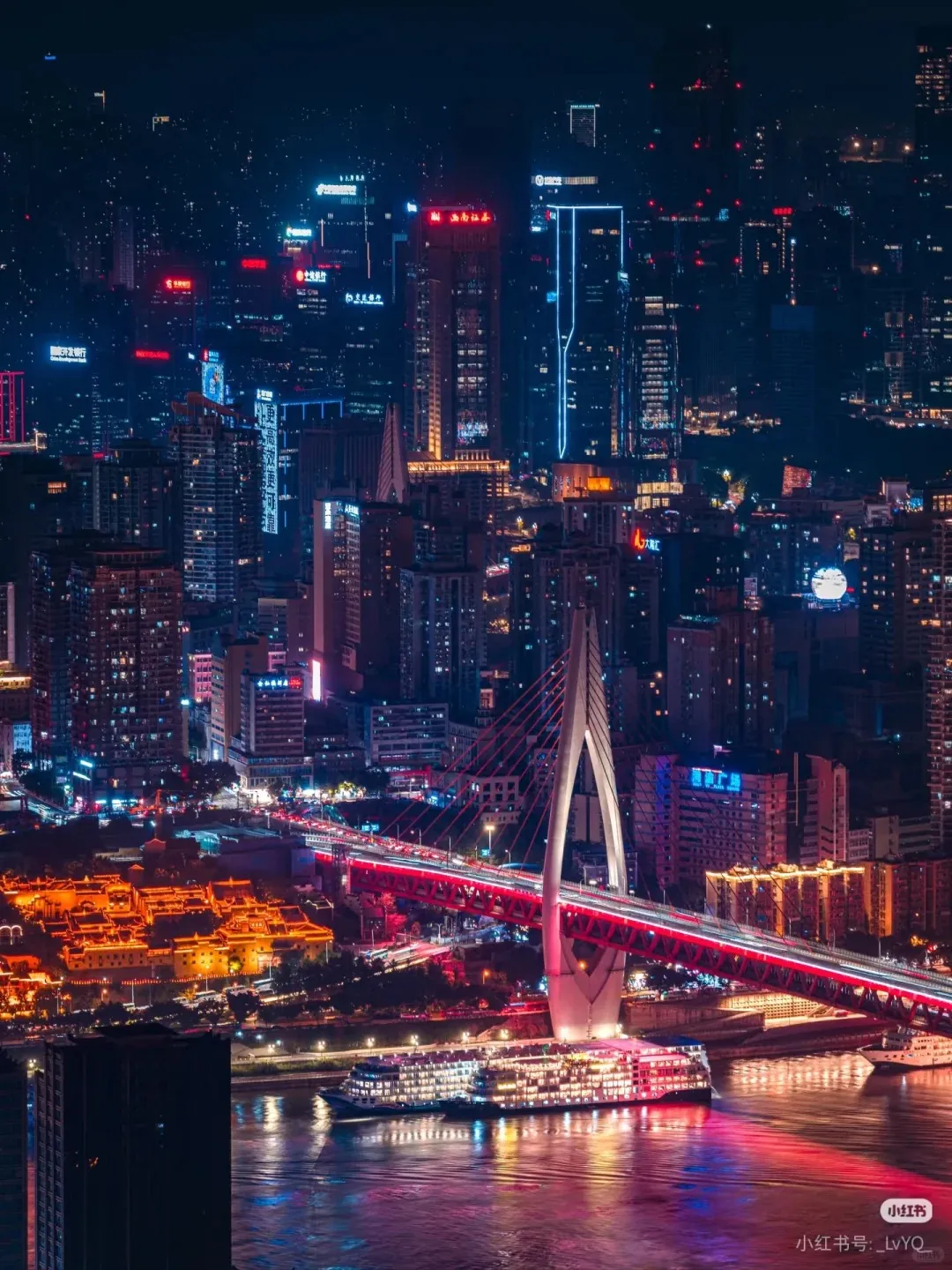
Chongqing’s iconic night view, often described as a ‘3D city’ or ‘cyberpunk wonderland,’ offers incredible photographic opportunities. Capturing its dramatic bridges, neon-lit skyscrapers, and bustling rivers at night requires the right gear – a sturdy tripod and a fast lens are absolute essentials for your China photography packing list.
What is the 100Wh Battery Rule?
Chinese Civil Aviation regulations strictly forbid checking lithium batteries in hold luggage. They must be in your carry-on. The limit is generally 100Wh (approximately 20,000mAh) per battery. Crucially, the capacity must be clearly printed on the device. If the label on your power bank is worn off or unreadable, security at Beijing or Shanghai airports will confiscate it without hesitation.
Plugs and Voltage
China operates on 220V. Most modern camera chargers are dual voltage (110V-240V), so you likely only need a plug adapter, not a voltage converter. China uses three plug types:
- Type A (Two flat pins): Same as North America (without the ground pin).
- Type I (Three angled pins): Same as Australia/New Zealand.
- Type C (Two round pins): Occasionally found in older buildings.