


The Hardware: Squat vs. Western Toilets
The first thing to understand is that the squat toilet is not a sign of poverty; it is a cultural preference for hygiene and anatomy. In 2026, you will encounter three main types of facilities.
The Standard Squat
This is a porcelain pan set flush into the floor. In modern cities like Shanghai or Shenzhen, these often feature automatic flush sensors and non-slip foot grooves. In older areas, they may be manually flushed. The primary benefit is that your body never touches a surface that others have sat on.
The Western “Sitter”
You will find Western-style seated toilets in airports, 4- and 5-star hotels, upscale malls (like Swire or MixC properties), and inside the “Accessible/Disabled” stalls of public restrooms. However, be warned: you may occasionally find shoe prints on the toilet seat. This happens when locals, accustomed to squatting, stand on the rim to avoid skin contact.
The “Village Pit”
If you venture off the beaten path to rural areas or hike the “Wild Wall,” you may encounter the infamous pit toilet. These are often partition-less trenches with no running water. While confronting, they are a reality of rural travel. A dab of tiger balm under the nose is a seasoned traveler’s trick to mask odors here.
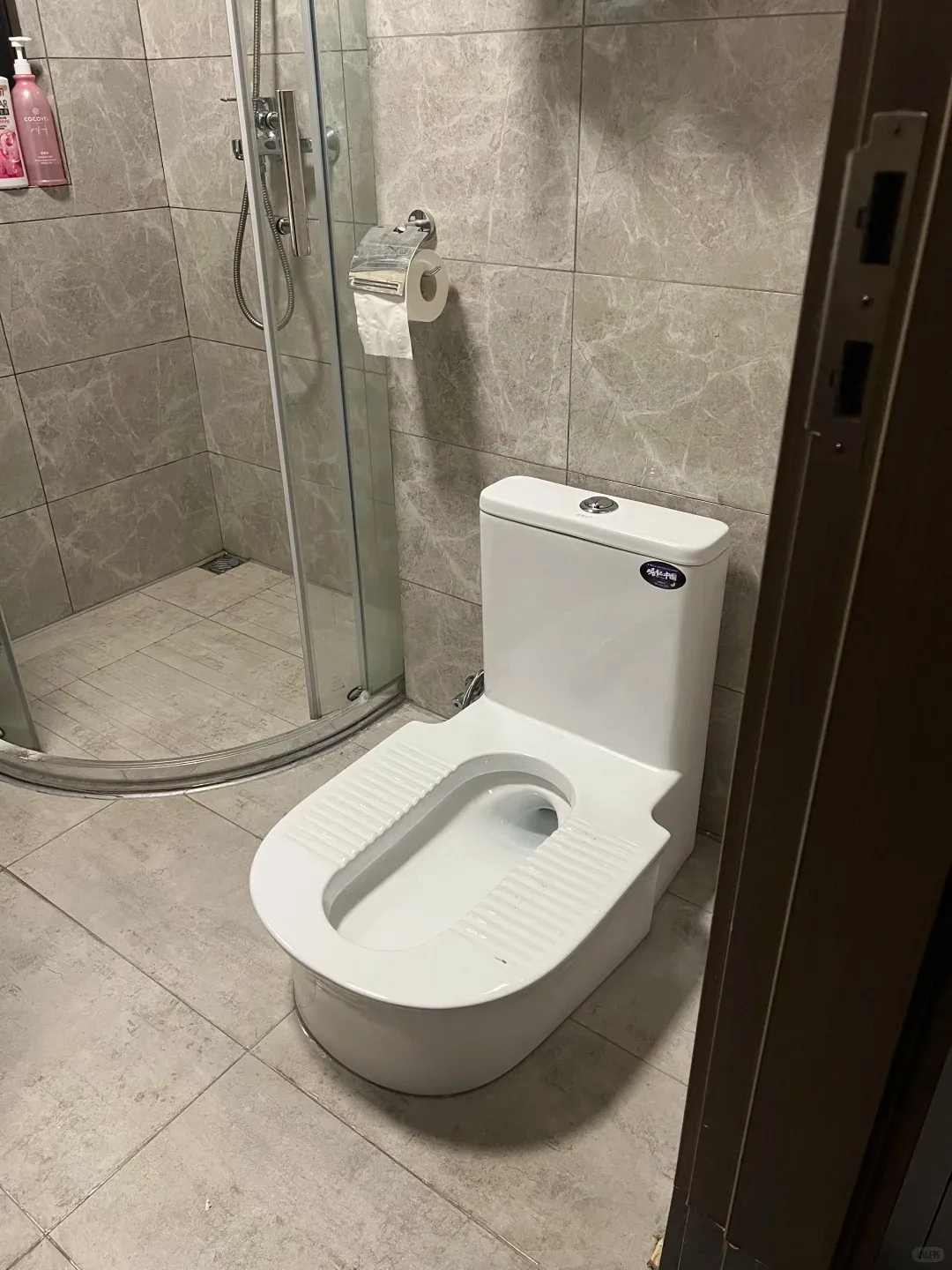
Beyond the common stereotype, many modern Chinese public toilets, particularly in newer establishments, feature elevated and clean squat models like this one, complete with anti-slip grooves for a more comfortable and hygienic experience. Our guide delves into navigating these and other options for travelers.
Insider Tip: The “Wet Floor” Phenomenon
One sensory detail that often surprises first-time visitors is the perpetually wet floor in public restrooms. This is rarely urine; it is usually aggressive cleaning.
Cleaning staff in China are incredibly diligent and mop floors constantly, often while you are still in the restroom. Wear closed-toe shoes. Navigating a public restroom in flip-flops is a rookie mistake that will leave you with wet, dirty feet.
Logistics: What to Pack in Your Day Bag
You cannot rely on the facility to provide amenities. Treat every restroom visit like a camping trip. Your daily carry should include:
- Tissue Packs: You can buy packets of “Tempo” tissues at any convenience store (7-Eleven, Lawson, FamilyMart). They are thicker than Western tissues and designed for restroom use.
- Hand Sanitizer: Soap dispensers are frequently empty or filled with watered-down liquid.
- A Hook or Carabiner: Many stall doors have broken locks or missing coat hooks. You need a way to keep your bag off the wet floor while you squat.
Staying Connected to Find Facilities
Finding a clean toilet in a massive city like Chongqing or Beijing requires data. You will need to use navigation apps to find the nearest mall or hotel. Do not rely on public Wi-Fi, which is often gated behind a Chinese phone number verification.
💡 Editor’s Pick: We recommend Nomad eSIM for China because it reliably bypasses the Great Firewall with stable speeds. Use code JORICAQLKF at checkout to get $5 USD off your first data plan.
How to Use a Squat Toilet (Step-by-Step)
If you have never used a squat toilet, the mechanics can be intimidating. Follow this process to avoid wardrobe malfunctions.
- The Setup: Ensure your phone is secure in a zipped pocket. If it falls out of a shallow pocket, it is gone forever.
- The Stance: Step fully forward so your feet are on the grooved sections. If you stand too far back, you risk missing the target.
- The Clothing: Do not pull your pants down to your ankles. The floor is wet. Pull them down to your knees and keep tension on the fabric to keep it off the ground.
- The Squat: Drop your hips as low as possible. This is the “Asian Squat”—heels flat on the floor. If you balance on your toes, your legs will shake, and you will lose stability.
- The Flush: Step away before flushing. The water pressure in some squat toilets is surprisingly violent and can splash back.
Navigation: Finding a Toilet in an Emergency
When you are exploring the city, look for the sign saying Public Toilet (公共厕所 – Gōnggòng Cèsuǒ). In recent years, China has built thousands of standalone public restrooms that are surprisingly well-maintained, often rated with stars like hotels.
Using Apps
Open Amap (Gaode Maps) or Baidu Maps. Even if you don’t read Chinese, you can type “WC” or “Toilet” into the search bar, and it will populate the nearest locations. Look for entries with photos to gauge cleanliness.
The Best “Secret” Restrooms
If you want to avoid the public street toilets, head to:
- Hotel Lobbies: Walk in with confidence. The lobby restrooms in international chains (Marriott, Hilton, Shangri-La) are always immaculate.
- Fast Food Chains: McDonald’s and KFC are ubiquitous and reliable.
- New Bookstores: China has a trend of massive, luxury bookstores (like Zhongshuge). Their restrooms are usually high-end.
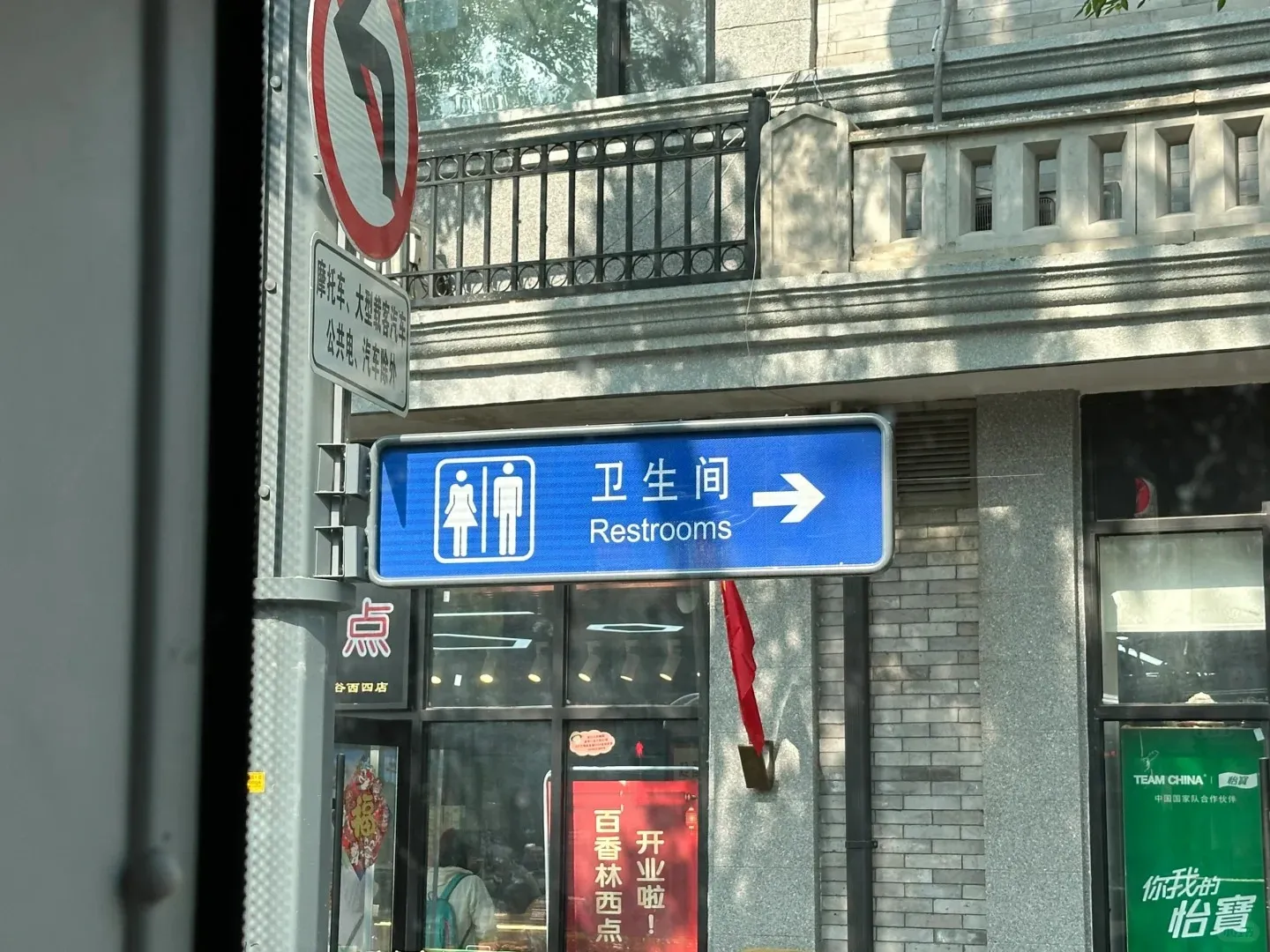
Finding a public toilet in China is often straightforward thanks to clear, bilingual signage like this. For travelers, spotting these signs means relief is near, and many modern facilities now offer both squat and Western-style options to accommodate everyone.
Toilets on Trains: High-Speed vs. Old School
Your experience on the rails will vary wildly depending on your ticket.
High-Speed Trains (G, D, C Class)
These trains feature Western-style toilets at one end of the car and squat toilets at the other. They are generally clean, vacuum-flush systems similar to airplanes. However, by the end of a long journey, the floors will be wet, and paper may run out.
Green/Slow Trains (K, Z, T Class)
Warning: The toilets on older overnight trains are strictly functional. They are stainless steel squat troughs. On older models, the waste is dumped directly onto the tracks. Consequently, the toilets are locked 15 minutes before the train arrives at a station and remain locked until it departs. Plan your schedule accordingly.
Cultural Etiquette and Privacy
Travelers often report feeling uncomfortable with the lack of privacy. In older public restrooms (hutongs in Beijing or rural stops), stall partitions may be low, or doors may be missing entirely. You might encounter locals having full conversations with each other while doing their business.
This is not considered rude in local culture. The best approach is to avert your eyes, focus on the task at hand, and get out. If there is a line, do not leave a large gap between you and the person in front, or someone will cut in. In China, a gap in the line is interpreted as you not being ready to move.