
- Visa-free transit requires third-country travel: To qualify for the 24/72/144-hour visa-free transit, your onward ticket must be to a different country or region than your departure point.
- Luggage isn’t always checked through: On international-to-domestic transfers, you usually must clear customs, collect your bags, and recheck them.
- Connectivity is an immediate hurdle: Airport Wi-Fi requires SMS verification. Since foreign networks often fail to receive these texts in China, pre-purchasing an eSIM is essential.
- Allow a 3-hour minimum buffer: Due to strict, multi-layered security and immigration fingerprinting protocols, tight layovers are highly risky.


What is the 144-Hour Visa-Free Transit?
The 144-hour visa-free transit is a Chinese immigration policy allowing passport holders from 54 eligible countries to enter specific Chinese regions without a visa for up to six days. You must hold a valid passport and a confirmed, non-stop onward flight ticket to a third country or region.
Understanding Transit Rules in 2026
According to the official National Immigration Administration of China, the transit policies are strictly enforced. The 24-hour transit applies nationwide and allows you to leave the airport, provided you have a connecting ticket within 24 hours.
The 72-hour and 144-hour policies are region-specific. For example, if you land in Shanghai (PVG), you can travel within Shanghai, Jiangsu, and Zhejiang provinces. Crucial rule: A round-trip ticket (e.g., London to Beijing to London) does not qualify. Your itinerary must look like London to Beijing to Tokyo.
Navigating Major Hubs: PVG, PEK, and CAN
The moment you step off the jet bridge, you will notice the distinct, polished hum of a Chinese mega-hub. The air often carries the faint, comforting smell of star anise and beef broth from the VIP noodle lounges. However, the walking distances are staggering.
Baggage Handling and Customs
If you are transferring from an international flight to a domestic Chinese flight, do not assume your bags will magically appear at your final destination. At airports like Guangzhou (CAN) and Beijing (PEK), you must physically collect your luggage, pass through the red or green customs channels, and re-check it.
Security at Chinese airports is incredibly thorough. You will be required to remove laptops, tablets, and power banks. Take note: Power banks over 100Wh (roughly 27,000 mAh) are strictly forbidden, and any power bank without a clear capacity label printed on it will be confiscated immediately.
Digital Logistics: Wi-Fi, eSIMs, and Payments
China operates on a completely different digital ecosystem. Western apps like Google Maps, WhatsApp, and Instagram are blocked by the Great Firewall. Furthermore, logging into free airport Wi-Fi almost always requires a Chinese phone number or a scanning kiosk to verify your passport.
To avoid being stranded without internet, buying a reliable travel eSIM before you board your flight is non-negotiable.
💡 Editor’s Pick: We recommend Nomad eSIM for China because it reliably bypasses the Great Firewall with stable speeds. Use code JORICAQLKF at checkout to get $5 USD off your first data plan.
Setting Up Alipay Before You Land
Cash is rarely used in modern China, even in airports. If you want to buy a ¥4 bottle of Nongfu Spring water from a terminal vending machine, you need mobile payments. Download the international version of Alipay or WeChat and link your foreign Visa or Mastercard before you leave home.
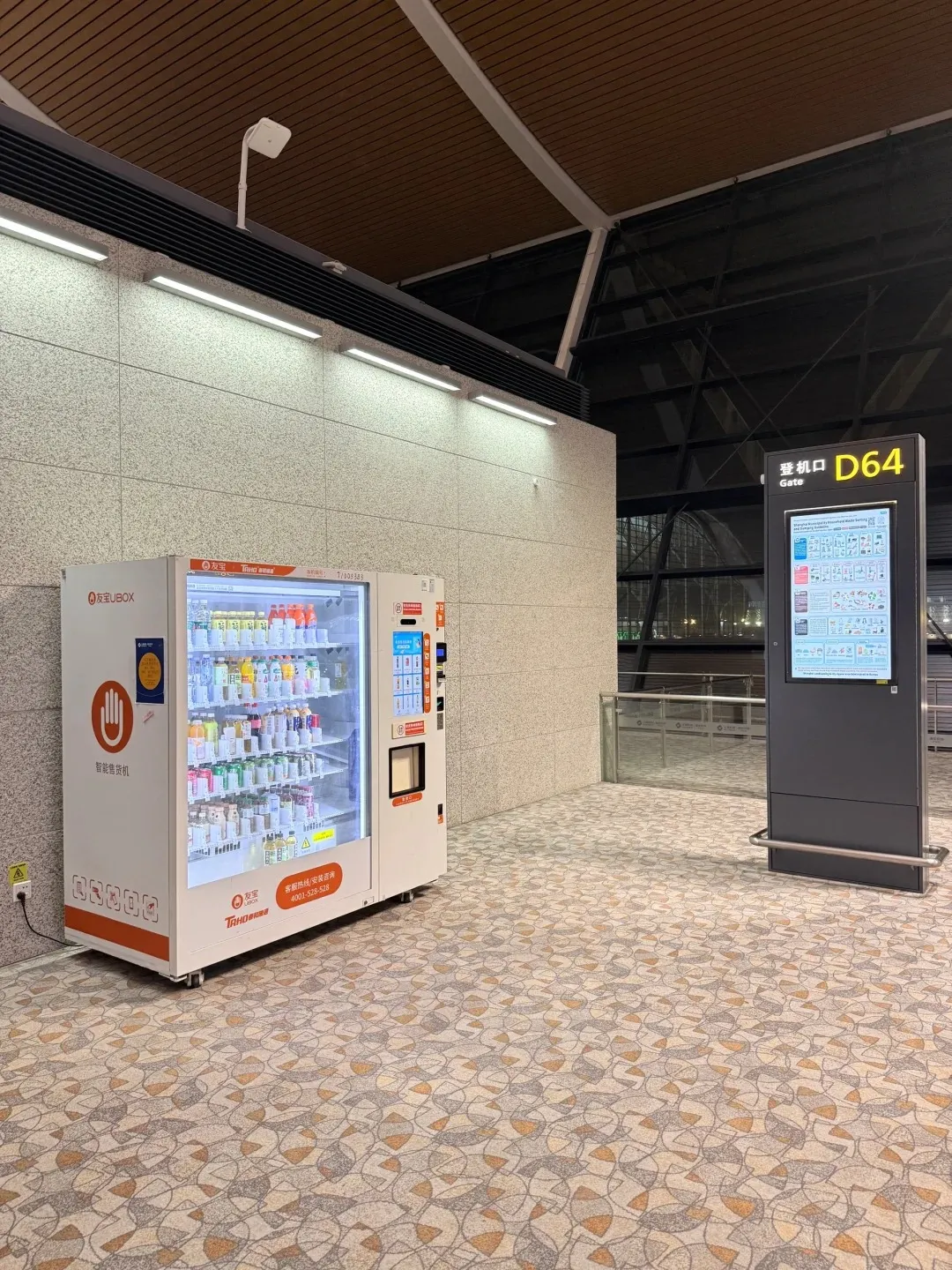
During your international airport transfers in China, you’ll find modern conveniences like these smart vending machines, perfect for grabbing a quick refreshment using common digital payment methods before heading to your next gate.
Insider Tip: Avoid the “Quick Layover Tour” Trap
Many travel blogs romanticize the idea of leaving Beijing Capital (PEK) during a 7-hour layover to quickly hike the Great Wall at Mutianyu. Do not do this.
While the 144-hour visa makes it legally possible, Beijing’s unpredictable traffic and the lengthy immigration queues for fingerprinting make a short excursion incredibly risky. Missing your onward international flight will cost you thousands.
If your layover is under 10 hours, book a room at an in-terminal transit hotel like the Aerotel at Daxing (PKX) or pay for lounge access. Enjoy a hot shower, order some authentic dim sum, and relax without the anxiety of missing your connection.