
Beyond the Crowds: Immersive Cultural Experiences with Guizhou's Ethnic Minorities

If you are looking for the China of twenty years ago—where wooden stilted houses cling to misty mountains and traditional dress is worn for daily life, not just for show—you need to look toward the southwest. Guizhou ethnic minority travel offers a raw, vibrant alternative to the polished tourism of Beijing or Shanghai. Home to 18 recognized minority groups, including the Miao, Dong, and Yi, Guizhou is a topographical puzzle of karst peaks and deep valleys that has preserved ancient customs for centuries.

However, the secret is out. High-speed rail has pierced these mountains, bringing both convenience and crowds. To find the authentic soul of the region, you must navigate carefully between commercialized “theme park” villages and the genuine, living communities that remain.

Quick Summary: Key Takeaways for Travelers

  • Best Base for Culture: Skip the provincial capital Guiyang for overnight stays; head straight to Kaili (for Miao culture) or Zhaoxing (for Dong culture).
  • The “Disneyfication” Warning: Xijiang Thousand Households Miao Village is impressive but extremely commercialized. For authenticity, choose Dali Dong Village or Matang Gejia Village instead.
  • Transportation Reality: High-speed trains get you to the prefecture centers, but you will need to hire a private driver (approx. 600–800 RMB/day) to reach the best villages efficiently.
  • Payment Essentials: Cash is rarely accepted, even in remote mountains. You must set up Alipay or WeChat Pay with your international credit card before arrival.
  • Weather Rule: The local saying is “No three days without rain.” Always pack a rain shell and shoes with grip for slippery cobblestones.

Summarize with :

Navigating the Villages: Tourist Traps vs. Hidden Gems

The biggest mistake travelers make in Guizhou is following the standard tour bus route without question. The government has aggressively developed tourism infrastructure, which is a double-edged sword. It means better roads, but also ticket gates and turnstiles at village entrances.

The Xijiang Dilemma

Xijiang Thousand Households Miao Village is the most famous spot in the region. Visually, it is stunning—a sea of wooden structures cascading down two hillsides. However, be prepared for shoulder-to-shoulder crowds, loud commercial music, and inflated prices (a bottle of water can cost 3x the normal price here).

Insider Tip: If you must visit Xijiang for the photo op, stay overnight. The day-trippers leave by 5:00 PM. The early morning mist over the village before 8:00 AM offers a glimpse of the tranquility that used to exist.
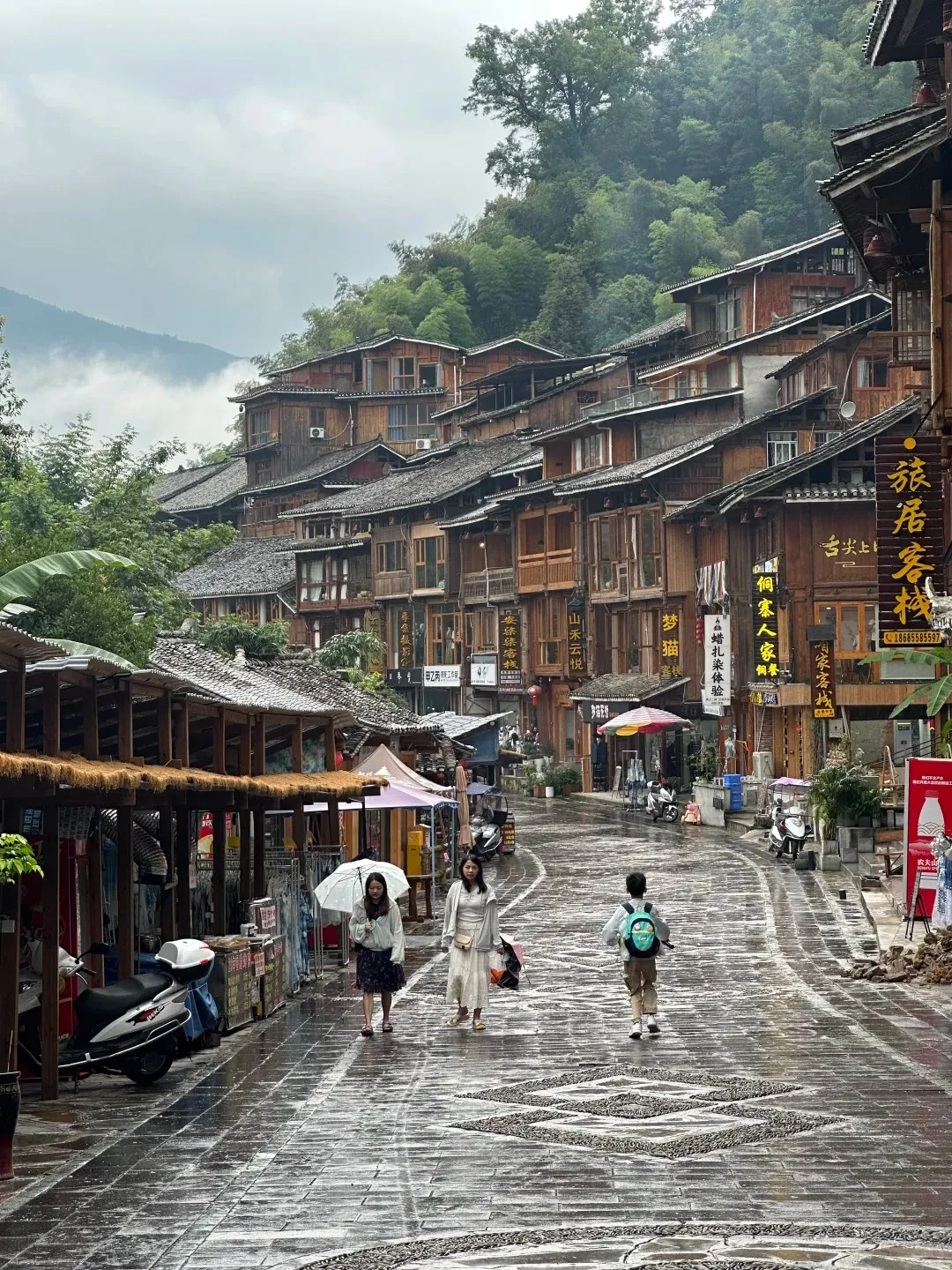
A traditional wooden stilt house village street on a rainy day. The wet cobblestone street, with decorative stone patterns, slopes uphill, lined with multi-story wooden houses featuring dark tiled roofs and balconies. Lush green trees and misty mountains are visible in the background. Several people are walking on the street, including two women with a white umbrella and a child with a blue backpack.

Explore the authentic heart of Guizhou’s ethnic minority culture, where traditional wooden stilt houses line ancient streets, even on a misty, rainy day. These villages offer immersive experiences, inviting you to connect deeply with a heritage that thrives beyond the usual tourist crowds.

Better Alternatives: Zhaoxing and Dali

For a more balanced experience, head to Zhaoxing Dong Village. While still popular, it retains a living atmosphere. The five Drum Towers (representing the five clans of the village) are architectural marvels built without a single nail. Here, you can hear the UNESCO-listed Grand Song of the Dong people—a polyphonic choir without a conductor or musical accompaniment.

contrarian Pick: For true silence and authenticity, go to Dali Dong Village (about 40 minutes from Zhaoxing). There are no souvenir stands, just ancient banyan trees, cobblestone paths, and locals dyeing cloth with indigo. It feels like stepping back into the Ming Dynasty.

Cultural Etiquette and “Road-Blocking” Customs

Guizhou ethnic minority travel is immersive, meaning you will likely participate in rituals. Understanding the rules of engagement prevents awkward social fumbles.

What is “Road-Blocking Wine”?

This is the traditional welcome ceremony (Lanmen Jiu) in Miao and Dong villages. Villagers stand in a line across the village entrance, singing toasts and offering rice wine. Crucial Etiquette: If you do not want to drink excessively, do not touch the bowl with your hands. If you touch the bowl, custom dictates you must finish the entire contents. Instead, keep your hands behind your back, bend forward to take a sip, and the server will take the bowl away.

The Gunmen of Basha

Basha Miao Village is the only place in China where civilians are legally permitted to own and carry guns. The men wear their hair in a traditional topknot (shaved with a sickle!) and carry long-barreled muskets. While the “gun salute” performance is staged for tourists, the lifestyle is real. Do not touch their weapons without explicit permission.

Logistics: Getting Around and Buying Tickets

Navigating Guizhou requires a mix of modern tech and old-school planning.

High-Speed Rail

The high-speed rail network is excellent. The hub is Guiyang North Station. From here, you can take a train to:

  • Kaili South (30 mins): Gateway to Miao villages (Xijiang, Langde).
  • Congjiang (1.5 hours): Gateway to Dong villages (Zhaoxing, Basha).

According to official railway policies, tickets go on sale 15 days in advance. During peak seasons (Golden Week in Oct, Labor Day in May), tickets sell out in seconds. Use Trip.com or the official 12306 app (which now has an English version) to book immediately when they release.

The “Last Mile” Problem

Public buses between villages are infrequent and often involve transfers in dusty county towns. To maximize your time, hire a private driver. You can arrange this through your hotel in Kaili or Zhaoxing. Expect to pay between 600 and 800 RMB per day for a driver who knows the winding mountain roads.
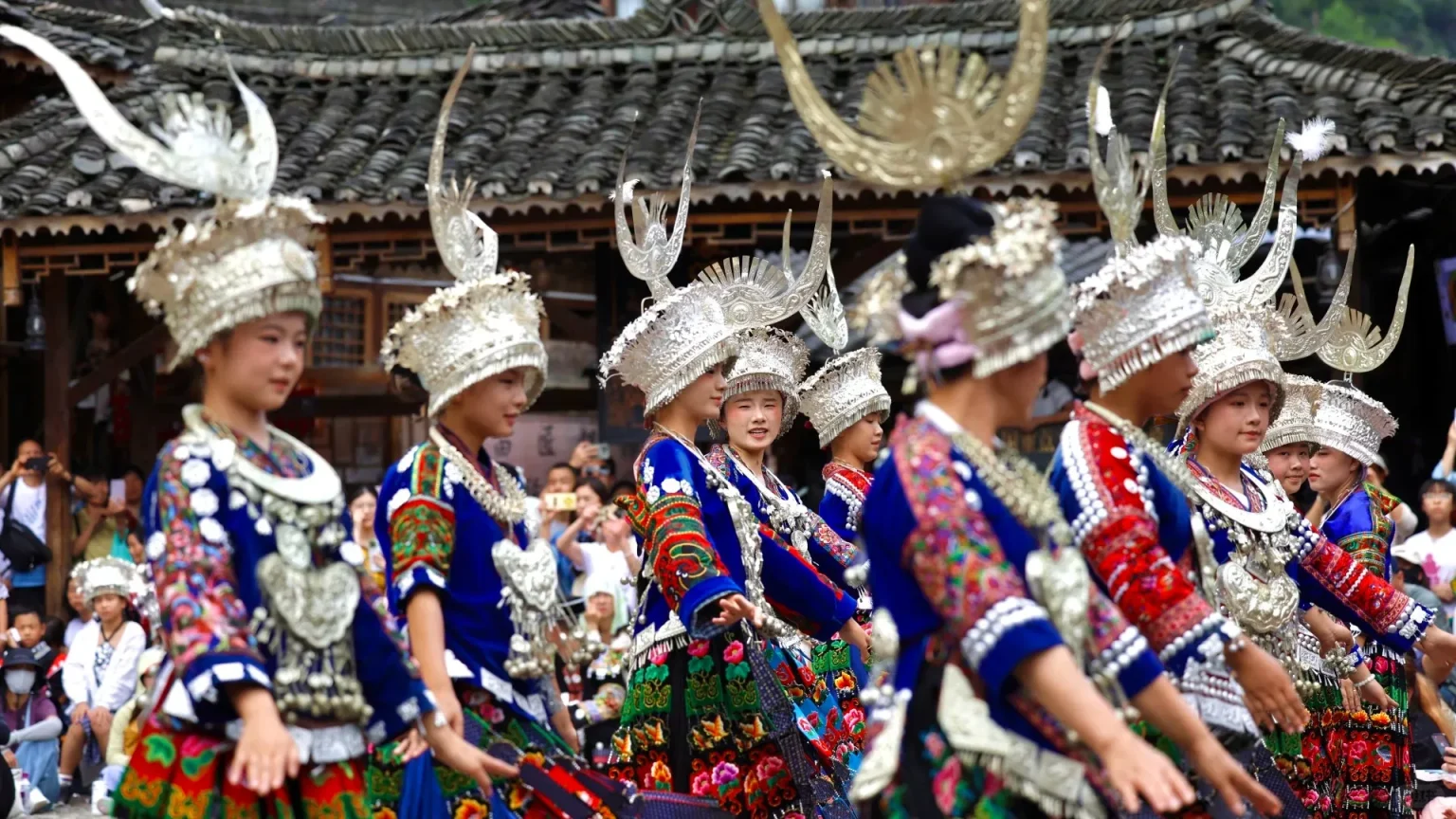
A line of young Miao ethnic women parade in vibrant traditional attire, featuring elaborate silver headdresses, ornate silver necklaces, and colorful blue, red, and green embroidered long-sleeved tops and skirts. Traditional buildings and blurred spectators are in the background.

Experience the vibrant heritage of Guizhou’s Miao ethnic minority as young women proudly display their stunning traditional silver headdresses and intricately embroidered clothing during a cultural parade. These dazzling ensembles are a highlight of local festivals, offering an immersive glimpse into their rich traditions.

A Taste of Guizhou: Sour, Spicy, and Aromatic

Guizhou cuisine is distinct from its neighbor, Sichuan. The heat here is a “sour spicy” (suan la), derived from fermented tomatoes and vegetables rather than peppercorns.

  • Sour Soup Fish (Suan Tang Yu): The province’s signature dish. A river fish boiled in a broth made of fermented tomatoes and rice water. It is tangy, rich, and perfect for the damp mountain weather.
  • Houttuynia (Zhe’ergen): The “Cilantro of Guizhou.” This is a pungent root vegetable with a strong fishy taste, used in dipping sauces. It is polarizing—you will either love it or hate it. If you have a sensitive palate, learn the phrase “Bu yao zhe’ergen” (I don’t want fish mint).
  • Maotai: Guizhou produces China’s most famous (and expensive) liquor, Maotai. It is a type of Baijiu (sorghum spirit). It is 53% alcohol and tastes like fire and soy sauce. Try it once for the experience, but sip slowly.

When to Go: Timing Your Trip

Avoid Chinese National Holidays at all costs. The narrow village streets become gridlocked.

The Sweet Spot: Late March to April, or September to October.

Festival Highlight: The Sisters’ Meal Festival (usually April) is the Miao equivalent of Valentine’s Day. Thousands of Miao women dress in elaborate silver headdresses and embroidered clothing to dance and exchange colored rice. It is a photographer’s dream, but book accommodation months in advance.
Essential Questions About Guizhou Travel Answered

What is the best way to get to Guizhou ethnic villages?

The most efficient route is taking the high-speed rail to Guiyang North Station, then transferring to Kaili South or Congjiang. From these hubs, hiring a private driver (approx. 600–800 RMB/day) is recommended to reach specific villages like Zhaoxing or Langde efficiently.

Surprisingly, no. Even in remote Guizhou mountains, cash is rarely accepted. It is essential to set up Alipay or WeChat Pay linked to your international credit card before you arrive to handle everything from street food to transport.

While visually stunning, Xijiang is heavily commercialized and crowded. For a more authentic experience with fewer tourists, it is better to visit Zhaoxing Dong Village or the quieter Dali Dong Village, though staying overnight in Xijiang offers a peaceful morning view.

This is a traditional welcome ceremony in Miao and Dong villages where locals offer rice wine at the entrance. If you do not wish to drink the whole bowl, keep your hands behind your back and bend forward to sip; touching the bowl signifies you will finish it all.

Conclusion

Guizhou is transforming rapidly. The dirt roads are being paved, and the wooden houses are being retrofitted with Wi-Fi. While the “untouched” China is harder to find, it still exists in the quiet mornings of Zhaoxing or the indigo-stained hands of a grandmother in Matang. A trip here is demanding—the roads are winding, the language barrier is high, and the weather is unpredictable—but the reward is an immersion into a culture that refuses to be homogenized. Pack your rain jacket, download your translation apps, and go now before the secrets are fully paved over.

Similar posts to this one

Multiple Fuxinghao high-speed bullet trains, silver with red and orange stripes, are parked at platforms inside Shenzhen North Railway Station at night. Station signs show '深圳北站' and 'Shenzhen North Railway Station'. Overhead metal structures and lighting are visible.

Beijing to Shanghai High-Speed Rail: The Complete Station & Seat Guide

For travelers in 2026, the debate between flying or taking the train from Beijing to Shanghai is effectively over. The [...]

A vibrant sunrise or sunset over the modern Beijing cityscape, featuring prominent skyscrapers like the tall, slender CITIC Tower (China Zun) reflecting golden light, the distinctive CCTV Headquarters building, and the spiraling dome of the Phoenix International Media Center. A dense canopy of green and golden trees forms the foreground under a sky with dramatic, colorful clouds.

Emergency Travel in China: Vital Phrases, Apps, and Safety Protocols

Traveling to China is an exhilarating experience, but the unique digital ecosystem and language barrier can make even seasoned globetrotters [...]

Two modern Chinese high-speed trains, including a silver Fuxing bullet train with red, orange, and gold stripes, parked side-by-side at a bright station platform. A white high-speed train with blue stripes is to the left. A yellow tactile paving strip is visible on the platform.

China High-Speed Rail for Tourists: Booking, Classes & Onboard Experience

For many travelers, the first time stepping into a Chinese railway station is more overwhelming than the flight that brought [...]

Get the China Arrival Survival Kit

Planning a trip here has a steep learning curve. Join our newsletter and receive our free “Day One Checklist” covering everything from setting up Alipay and WeChat to bypassing the internet firewall.