
Pu'er Tea Pilgrimage: Exploring Yunnan's Ancient Tea Mountains

For tea enthusiasts, the damp, earthy aroma of authentic, aged fermented tea is nothing short of intoxicating. But finding the true source of this legendary brew requires venturing far beyond the polished teahouses of Beijing or Shanghai. You have to travel deep into the misty, subtropical highlands of China’s southwestern Yunnan province.

Planning a dedicated Pu’er tea tour is often the most rewarding way to experience the Ancient Tea Horse Road. However, navigating the remote corners of Xishuangbanna and Pu’er City in 2026 requires careful logistical planning, a high tolerance for winding mountain roads, and knowing exactly how to avoid overpriced tourist traps.

TL;DR: Trip Essentials

  • Basecamp: Fly into Jinghong (Xishuangbanna Gasa Airport) or take the high-speed train from Kunming to start your tea pilgrimage.
  • Top Destination: Jingmai Mountain, officially recognized as a UNESCO World Heritage site, offers the most pristine ancient tea forests.
  • Best Markets: Skip the boutique shops in the city and head to the sprawling Menghai Market to buy directly from Akha and Bulang farmers.
  • Digital Prep: Cash is rarely accepted. You must set up Alipay or WeChat Pay and secure a reliable VPN-enabled eSIM before landing.

Summarize with :

What is the 144-Hour Visa-Free Transit for Yunnan?

The 144-hour visa-free transit allows eligible travelers from 54 countries to explore Yunnan Province for up to six days without a pre-approved tourist visa. You must enter via Kunming Changshui International Airport and hold a confirmed onward ticket to a third country outside of Mainland China.

Getting There: Navigating Southern Yunnan Logistics

Southern Yunnan is remote, but infrastructure has improved drastically. Most travelers start by flying into Kunming and taking the China Railway High-speed (CRH) train directly down to Xishuangbanna (Jinghong). According to the official 12306 rail policy, foreign passports can now be seamlessly verified online, allowing you to scan your physical passport at the electronic turnstiles.

Once you arrive, staying connected is your biggest hurdle. China’s Great Firewall blocks Google Maps, WhatsApp, and most Western social media. You need a reliable eSIM to use local ride-hailing mini-programs on WeChat.

💡 Editor’s Pick: We recommend Nomad eSIM for China because it reliably bypasses the Great Firewall with stable speeds.

Within Jinghong, DiDi (China’s Uber) is cheap and plentiful. However, to reach the tea mountains, you will need to hire a private driver through your hotel or book a specialized local guide. Do not attempt to rent a car; the mountain switchbacks are notoriously steep, and local driving etiquette is aggressive.

A panoramic view of a valley filled with thick, soft clouds at sunrise. The clouds are a warm orange and pink hue, reflecting the dawn sky. Distant, layered mountains are visible through the mist, fading into the horizon. In the foreground, silhouetted trees and the roof of a building are visible.

The magical ‘sea of clouds’ that blankets Jingmai Mountain at dawn, a breathtaking spectacle that often greets those embarking on a pilgrimage to Yunnan’s ancient tea gardens.

Exploring Jingmai Mountain: The Birthplace of Tea

Rising above a thick sea of morning clouds, Jingmai Mountain is the crown jewel of any Yunnan tea expedition. Home to million-tree ancient tea forests, the region feels entirely detached from modern China. The air here smells distinctly of roasting leaves and damp pine.

Spend your time exploring Wengji and Nuogan villages. These traditional Bulang and Dai minority settlements feature stilted wooden houses where families have processed tea for over a millennium. You can walk right into a farmer’s courtyard and watch them pan-fry fresh leaves in massive iron woks.

Insider Tip: Skip the Overrated “Gushu” Boutiques

A common mistake first-time visitors make is dropping hundreds of dollars on so-called “Gushu” (ancient tree) tea in Jinghong’s commercial tourist districts. Much of this is blended with cheaper plantation tea. Instead, buy directly from the farmers in Wengji. You will pay a fraction of the price, and the money goes directly to the local indigenous communities.

Best Estates and Markets for an Authentic Tasting

If you want to understand the economics of the Tea Horse Road, you must visit the Menghai Market. Arrive by 7:00 AM to witness a chaotic, sensory overload. You will see farmers hauling massive woven sacks of raw tea leaves, haggling loudly over prices while smoking bamboo water pipes.

For a more structured tasting, head to Nannuo Mountain. The Akha minority women here will guide you through dirt paths lined with yellow wildflowers to 800-year-old tea trees. A traditional tasting ceremony usually involves brewing the dark, fermented leaves in gaiwans (lidded bowls).

Pricing expectations: A standard 350g disc of decent, mid-tier raw (Sheng) Pu’er directly from a Nannuo farmer will cost you around 400 to 600 RMB. High-end, naturally aged ripe (Shou) Pu’er can easily run into the thousands.
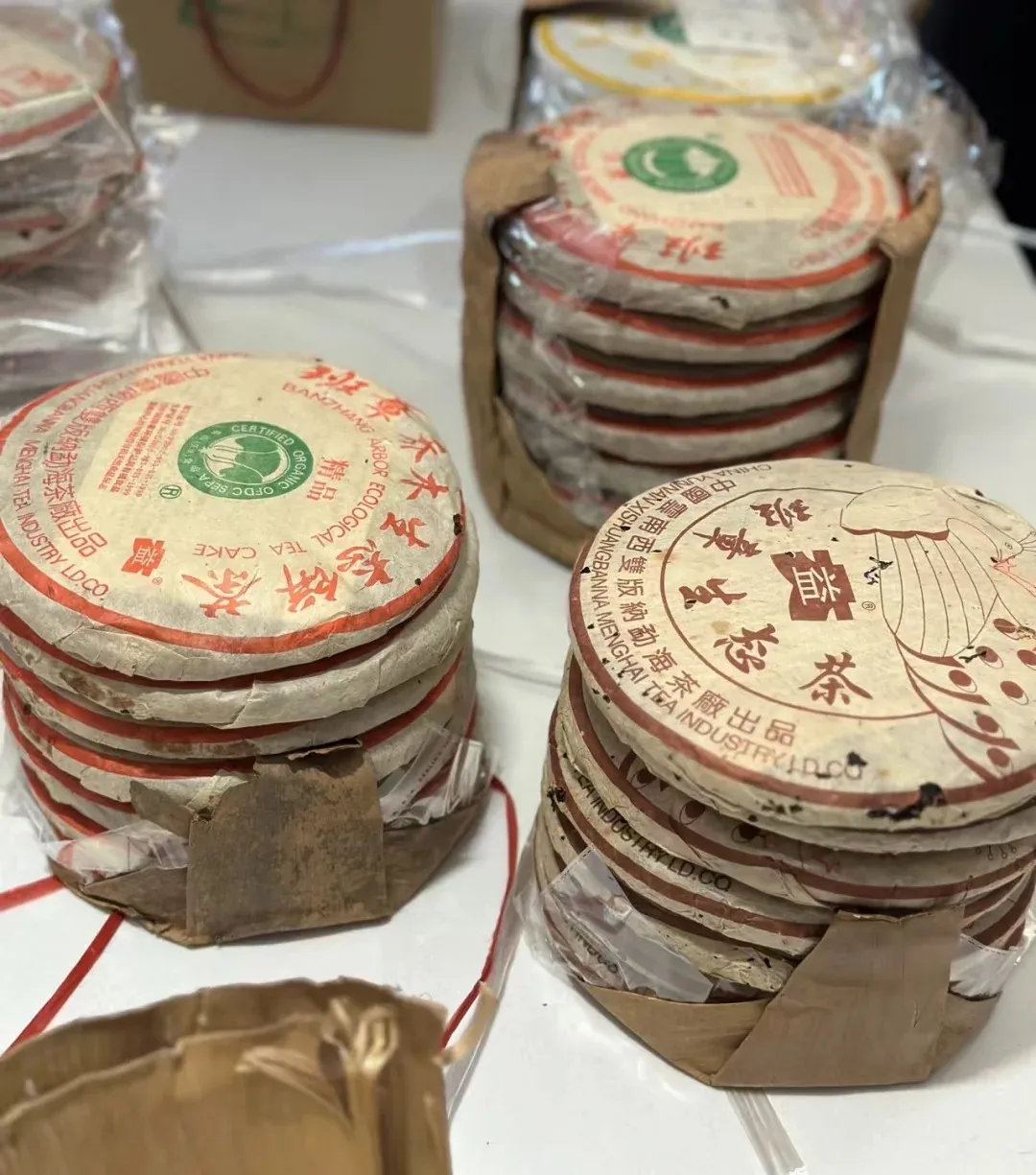
Several stacks of compressed Pu'er tea cakes with red and white circular wrappers. Some wrappers have green certification logos and Chinese characters. The cakes are partially wrapped in brown paper and plastic.

Stacked high with the promise of rich flavor, these Pu’er tea cakes are a common sight in the markets of Yunnan’s ancient tea mountains. Each disc represents a journey from the terraced gardens to your teacup.

The Realities of a Yunnan Tea Trek: What to Expect

Social media often romanticizes the tea mountains, but a real trek requires grit. The humidity in Xishuangbanna is oppressive from May to September. You will sweat through your clothes within minutes of hiking the agro-forests.

Furthermore, English is virtually non-existent outside of luxury resorts like the Bolian Resort & Spa. You must have a translation app like Baidu Translate downloaded for offline use. When trekking, carry plenty of water. A standard bottle of Nongfu Spring water costs just 2 RMB at village kiosks, but these shops are miles apart on the trails.

Finally, be prepared for the taste. If you have never had authentic, aged Pu’er, the first sip can be jarring. It tastes like the forest floor—earthy, mushroomy, and deeply mineral. But by your third cup, the sweet, lingering aftertaste (known as hui gan) will completely win you over.


Yunnan Tea Travel Frequently Asked Questions

Do I need a visa to visit Yunnan, China?

Eligible travelers from 54 countries can utilize the 144-hour visa-free transit to explore Yunnan Province for up to six days without a traditional tourist visa. You must enter via Kunming Changshui International Airport and hold a confirmed onward ticket to a third country.

Cash is rarely accepted in China today, even in remote areas like the Menghai Market. First-time visitors must set up digital payment mini-programs like Alipay or WeChat Pay before landing to purchase items directly from local farmers.

The most efficient route is to fly into Kunming and take the China Railway High-speed (CRH) train directly south to Xishuangbanna (Jinghong). Foreign travelers can now verify their passports online and simply scan the physical document at the electronic turnstiles.

China’s Great Firewall blocks popular Western apps like Google Maps and WhatsApp. To navigate, use translation apps, and book local DiDi rides, you must secure a reliable VPN-enabled eSIM prior to your arrival.

Conclusion

A journey to the ancient tea mountains of southern Yunnan is not your typical vacation. It is a rugged, deeply cultural immersion into the roots of global tea history. From the chaotic morning markets of Menghai to the silent, cloud-covered canopy of Jingmai Mountain, a well-planned Pu’er tea tour offers a rare glimpse into a vanishing way of life. Secure your Chinese visa, download your payment apps, and prepare your palate for the most complex cup of tea you will ever experience. Ready to plan the rest of your itinerary? Read our comprehensive guide to navigating China’s high-speed rail network next.

Similar posts to this one

A large table laden with a grand feast, centered around a copper hotpot filled with orange broth. Surrounding the hotpot are numerous plates of Yunnanese dishes, including sliced mango, various salads, fried snacks, a wrapped dish, and a prominent mushroom-themed display with Chinese characters. The setting is a traditional wooden-paneled restaurant with large windows offering a scenic view of a lake, lush green trees, and distant people.

Yunnan's Mushroom Hotpot: A Traveler's Guide to a Fungal Feast

There is a saying in Yunnan: "If you eat wild mushrooms and don't see the little green men, you didn't [...]

An expansive aerial view of the Dongchuan Red Land, showing a village situated amidst rolling hills with striking red soil terraced fields and patches of green crops. Distant mountains rise in the background under a blue sky, and winding dirt roads traverse the landscape.

Dongchuan Red Land: How to Visit China’s Most Colorful Landscape

Imagine a landscape that looks less like Earth and more like an oil painting left out in the rain. Located [...]

A white and yellow high-speed train travels on a curving concrete railway viaduct through lush green, terraced mountainsides. In the background, misty blue mountains rise under a cloudy sky.

China-Laos Railway Travel Guide: Kunming to Luang Prabang by Train

Gone are the days of the grueling 27-hour "sleeper bus" from Kunming to Luang Prabang, a rite of passage that [...]

Get the China Arrival Survival Kit

Planning a trip here has a steep learning curve. Join our newsletter and receive our free “Day One Checklist” covering everything from setting up Alipay and WeChat to bypassing the internet firewall.