
Anyue Stone Carvings: A Guide to Sichuan's Hidden Grottoes

If you want to experience ancient Chinese Buddhist art without battling umbrella-wielding tour groups, you need to look beyond the famous Longmen or Mogao caves. Nestled in the humid, rolling hills between Chengdu and Chongqing lies a spectacular alternative. The Anyue Stone Carvings: A Guide to Sichuan’s Hidden Grottoes is your roadmap to over 100,000 decentralized, incredibly preserved statues dating back to the Tang and Song dynasties. Unlike the highly commercialized Dazu Rock Carvings nearby, Anyue offers a raw, atmospheric journey into China’s ancient past.

TL;DR: Trip Essentials

  • Location: Anyue County, Ziyang City, Sichuan Province (equidistant between Chengdu and Chongqing).
  • Best Transport: Take a high-speed train to Anyue Station, then hire a private local driver for the day (approx. 300-400 RMB) as the caves are miles apart on rural roads.
  • Top Priority Sites: Pilu Cave (for the Purple Bamboo Guanyin) and Mingshan Temple (for towering, wind-eroded guardian figures).
  • Time Needed: 1 full day from either Chengdu or Chongqing.
  • Cost: Entrance fees are highly localized, ranging from 15 to 30 RMB per site. Cash is rarely accepted; set up Alipay before arrival.

Summarize with :

What is the 144-hour visa-free transit policy?

According to the National Immigration Administration of China, the 144-hour visa-free transit policy allows eligible travelers from 54 countries to enter specific Chinese regions without a visa for up to six days. You must hold a valid passport and a confirmed onward ticket to a third country or region. Both Chengdu and Chongqing are approved entry ports for this policy.

Logistics: Getting to Anyue in 2026

Booking Your Train Tickets

Thanks to recent high-speed rail expansions, reaching Anyue is faster than ever. Trains depart frequently from both Chengdu East and Chongqing North stations, taking under an hour. According to the official 12306 rail policy, foreign travelers can now seamlessly verify their passports online and use e-tickets. You simply scan your passport at the turnstile—no paper tickets required.

Navigating the Rural Roads

Here is a critical insider tip: Do not rely on ride-hailing apps like Didi once you leave Anyue town. While you can easily get a Didi from the high-speed rail station to your first cave, finding a return ride on a remote, single-lane dirt road is nearly impossible. Hire a local taxi driver for the entire day right at the station. Negotiate a day rate (usually around 350 RMB) to wait for you at each site.

To navigate China’s digital landscape, order rides, and translate signs, you need a reliable internet connection. The Great Firewall blocks many international apps, and public Wi-Fi requires a Chinese phone number.

💡 Editor’s Pick: We recommend Nomad eSIM for China because it reliably bypasses the Great Firewall with stable speeds.

Which Grottoes Are Actually Worth Your Time?

With over 200 distinct carving sites scattered across the county’s bamboo-forested hills, trying to see them all is a common mistake to avoid. Attempting more than four sites in a single day leads to severe temple fatigue. Focus your itinerary on these masterpieces.
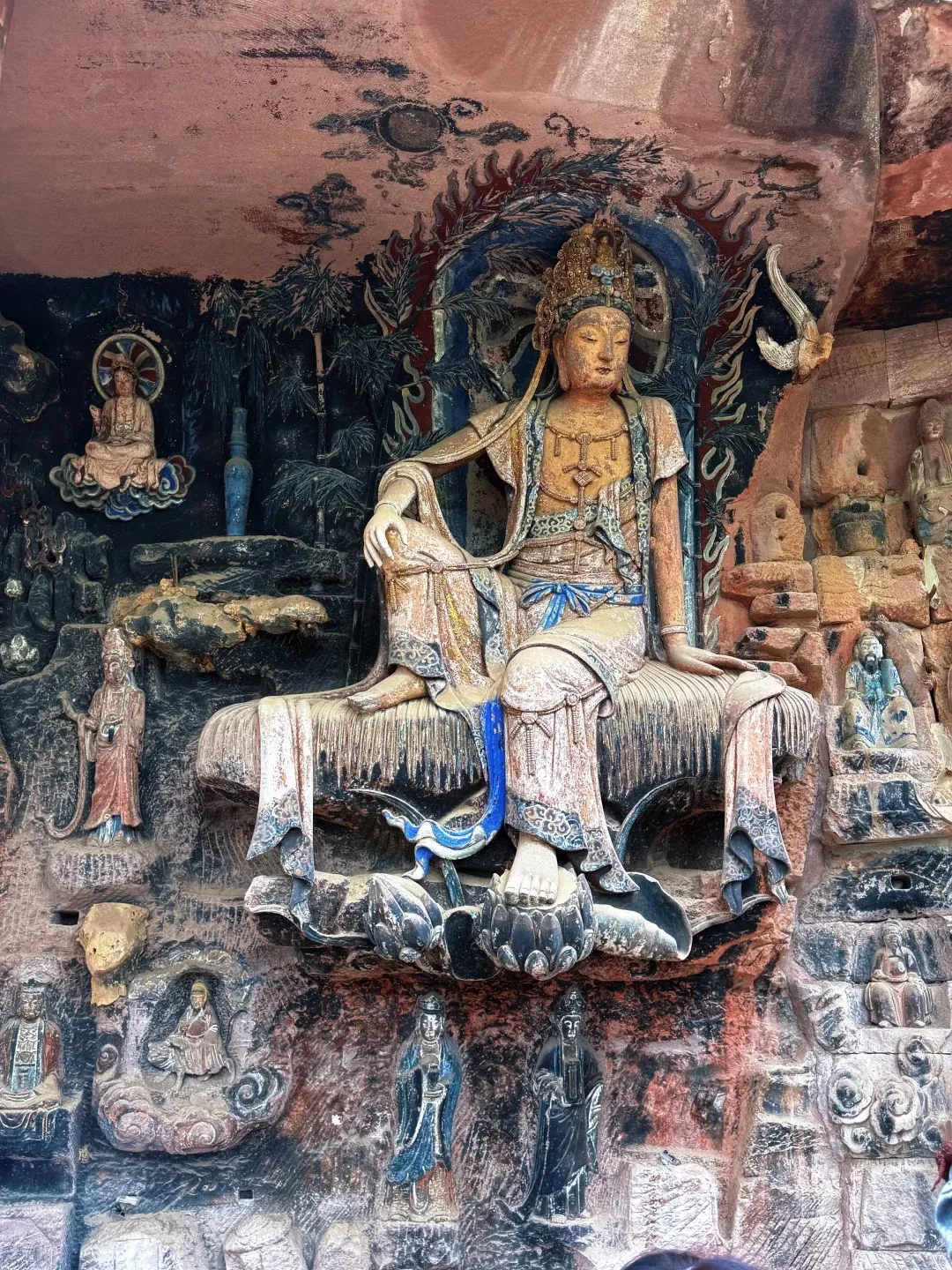
A large, seated stone sculpture of Guanyin (Purple Bamboo Guanyin) with a crown, adorned in flowing robes, resting on a lotus pedestal carved into a rock face. Smaller figures and decorative carvings surround the main sculpture within a grotto.

The magnificent Purple Bamboo Guanyin at Anyue’s Pilu Cave, a prime example of the region’s remarkable grotto art, showcasing the artistic mastery of Sichuan’s ancient sculptors.

1. Pilu Cave (Piludong): The Must-See Masterpiece

If you only visit one site, make it Pilu Cave. It is home to the spectacular Purple Bamboo Guanyin (Zizhu Guanyin). Unlike traditional stiff, upright Buddhist statues, this Song dynasty Guanyin sits in a strikingly relaxed, asymmetrical pose with one foot resting on a lotus leaf. The delicate carving of her flowing robes and the serene, slightly downward gaze make it an absolute masterpiece of ancient Chinese aesthetics.

2. Mingshan Temple (Mingshansi): The Atmospheric Secret

Perched atop a steep hill, Mingshan Temple is deeply atmospheric. What to Know Before You Go: The road here is rough, and the scent of damp moss and burning sandalwood hangs heavy in the humid Sichuan air. The statues here are exposed to the elements, resulting in haunting, wind-eroded guardian figures that look organically molded from the mountain itself. You will likely be the only tourist here.

3. Yuanjue Cave (Yuanjuedong): The Accessible Intro

Located just outside Anyue’s main town center, Yuanjue Cave is the most developed site. It features three massive, beautifully preserved statues of Buddha and Bodhisattvas. Because it is closer to town, you will encounter more local worshippers here. It is a great place to observe modern devotion intersecting with ancient art.

What to Skip: The Overrated Sites

Skip the smaller, highly restored sites like Baosen Temple. While historically significant, recent decades of overly enthusiastic “restoration” have painted over the ancient stone with garish, bright modern paints. It strips away the historical gravitas you came to Anyue to experience. Stick to the raw, unpainted stone of Mingshan and Pilu.
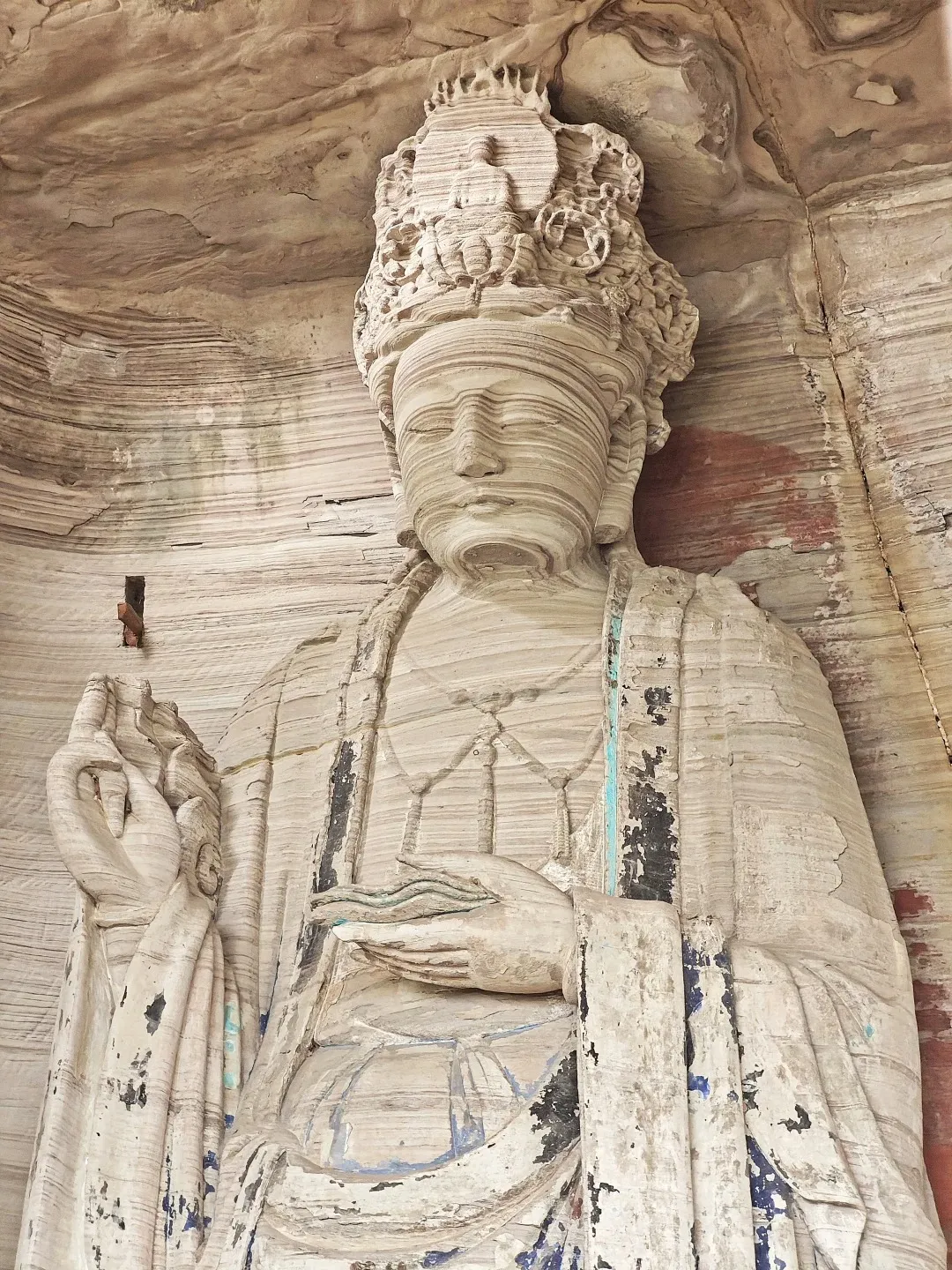
A close-up, low-angle view of a large, weathered stone carving of a serene Buddhist figure, likely a Bodhisattva, set within a rock grotto. The statue has intricate details in its headdress, facial features, and flowing robes, with visible layers of sedimentary rock forming its structure. Patches of blue and red pigment are still visible on the surface, indicating past coloration.

A testament to ancient artistry, this majestic stone carving in Anyue reveals the intricate details of Buddhist iconography. Discovered within Sichuan’s hidden grottoes, such as those at Mingshan Temple, these sculptures offer a glimpse into a rich artistic and spiritual heritage.

Practical Tips for Your 2026 Visit

Dealing with the Elements

Sichuan’s basin climate means extreme humidity from May to September. The stone steps leading up to the grottoes become dangerously slick with moss. Wear hiking shoes with aggressive traction. Be prepared for the relentless hum of cicadas in the summer, which can be deafening but adds to the wild, forgotten feel of the area.

Food and Hydration

There are no commercialized food courts at these remote sites. At the entrance to Pilu Cave, you might find a local farmer selling snacks. A cold bottle of Nongfu Spring water costs just 2 RMB, and a bowl of spicy, numbing Anyue lemon noodles at a roadside stall will run you about 10 RMB. Always pay with Alipay or WeChat Pay; rural vendors rarely carry change for 100 RMB notes anymore.

Photography Etiquette

Unlike the strict no-photography rules inside the caves at Dunhuang, Anyue generally permits photography. However, always turn off your flash to protect the ancient pigments, and be respectful of local monks and worshippers who are actively using these sites for prayer.

Common Questions About Visiting Anyue, China

Do I need a visa to visit Anyue from Chengdu or Chongqing?

If you are from one of the 54 eligible countries, you can utilize China’s 144-hour visa-free transit policy. This allows you to enter through Chengdu or Chongqing airports for up to six days without a formal visa, provided you have a confirmed onward ticket to a third country.

No, cash is rarely accepted in rural areas. You should set up Alipay or WeChat Pay before your trip, as even small roadside vendors and local transport services now rely almost exclusively on mobile digital payments.

Because the sites are scattered across rural Anyue, you should not rely on ride-hailing apps like Didi for return trips. The best approach is to hire a local driver for the entire day at the Anyue high-speed rail station to wait for you at each location.

The Sichuan basin experiences extreme humidity from May to September, which can make the stone steps slippery and the heat intense. Consider visiting in the spring or autumn for more comfortable hiking conditions while exploring these outdoor sites.

Exploring the Anyue Stone Carvings offers a rare, unfiltered glimpse into China’s rich artistic heritage, far removed from the megaphone-toting tour guides of major cities. By securing your high-speed train tickets early, hiring a dedicated local driver, and prioritizing the masterpieces at Pilu Cave and Mingshan Temple, you guarantee a seamless off-the-beaten-path adventure. If you are basing your trip out of Sichuan’s capital, be sure to read our comprehensive guide to navigating Chengdu like a local.

Similar posts to this one

A scenic view from above a canal in Suzhou, China, at sunset. Traditional buildings with tiled roofs line the canal, adorned with glowing red lanterns. Several boats are on the water, some with people on board, and others are docked along the side where there are shops and eateries. The sky transitions from a soft orange and yellow near the horizon to a pale blue with scattered clouds.

Beyond the Loom: A Practical Guide to Buying Authentic Suzhou Silk

Beyond the Loom: A Practical Guide to Buying Authentic Suzhou Silk TL;DR: Trip Essentials Buy on Pingjiang Road, not the [...]

An open-air teahouse with a dark wooden roof supported by large wooden pillars. Many people are seated at bamboo tables and chairs, some eating and some drinking. In the foreground, a man in a dark t-shirt and yellow shorts leans back in his chair at a table with a bottle and a cup. Orange lanterns hang from the ceiling. The floor is wet and reflective.

Chengdu's Ancient Teahouses: A Guide to Local Brews & Cultural Immersion

If you want to understand the true heartbeat of Sichuan province, you have to slow down. While the modern metropolis [...]

A traditional wooden boat with a thatched roof navigates a narrow canal lined with stone walls. A person wearing a conical straw hat and an orange life vest steers the boat with a long pole. Other boats with passengers are visible further down the canal, and traditional Chinese architecture with tiled roofs and lanterns lines the left bank. Lush green trees and vibrant pink and white flowers bloom along the canal's edge.

A Perfect 1-Day Suzhou Itinerary: Classical Gardens & Pingjiang Road

Trying to squeeze the "Venice of the East" into a single day can feel overwhelming, but a well-planned 1 Day [...]

Get the China Arrival Survival Kit

Planning a trip here has a steep learning curve. Join our newsletter and receive our free “Day One Checklist” covering everything from setting up Alipay and WeChat to bypassing the internet firewall.