
Discovering the Hanging Coffins of the Bo People: A Guide to Gongxian

Deep in the misty karst mountains of southern China, hundreds of ancient wooden coffins defy gravity, suspended on sheer cliff faces hundreds of feet in the air. For travelers seeking authentic, off-the-beaten-path history, navigating the remote reaches of Yibin municipality is a necessary pilgrimage. If you are planning a trip to uncover this 600-year-old mystery, this Gongxian hanging coffins Sichuan guide provides the exact logistics, costs, and realities of reaching the lost world of the Bo people in 2026.

TL;DR: Trip Essentials

  • Location: The coffins are located in Luobiao Town, within Gongxian County, part of Yibin City in southern Sichuan.
  • Getting There: Take a 90-minute high-speed train from Chengdu to Yibin, followed by a local bus from Yibin Nan’an Bus Station to Luobiao.
  • Cost: The outdoor site is free to view. A small ¥10-¥20 cash donation is customary at the entrance museum.
  • Best Time to Visit: Arrive at sunrise when the morning light hits the eastern-facing cliffs, cutting through the dense valley fog.
  • Connectivity: Rural Sichuan has limited Wi-Fi. Download offline translation apps and secure a reliable eSIM before arriving.

Summarize with :

What is the 144-Hour Visa-Free Transit in Sichuan?

The 144-hour visa-free transit policy allows eligible travelers from 54 countries to enter China without a prior visa for up to six days. If you fly internationally into Chengdu Tianfu International Airport, you can legally travel throughout the entire Sichuan province, including Yibin and Gongxian, before departing to a third country.

The Mystery of the Bo People

The Bo people were an ethnic minority who thrived in southern Sichuan during the Ming Dynasty before mysteriously vanishing. Instead of burying their dead in the earth, they carved coffins from massive, heavy logs and suspended them on wooden stakes driven into vertical limestone cliffs. Today, roughly a third of the original 300 coffins have fallen as the 600-year-old wooden supports succumb to rot, making this a fragile historical site that will not last forever.
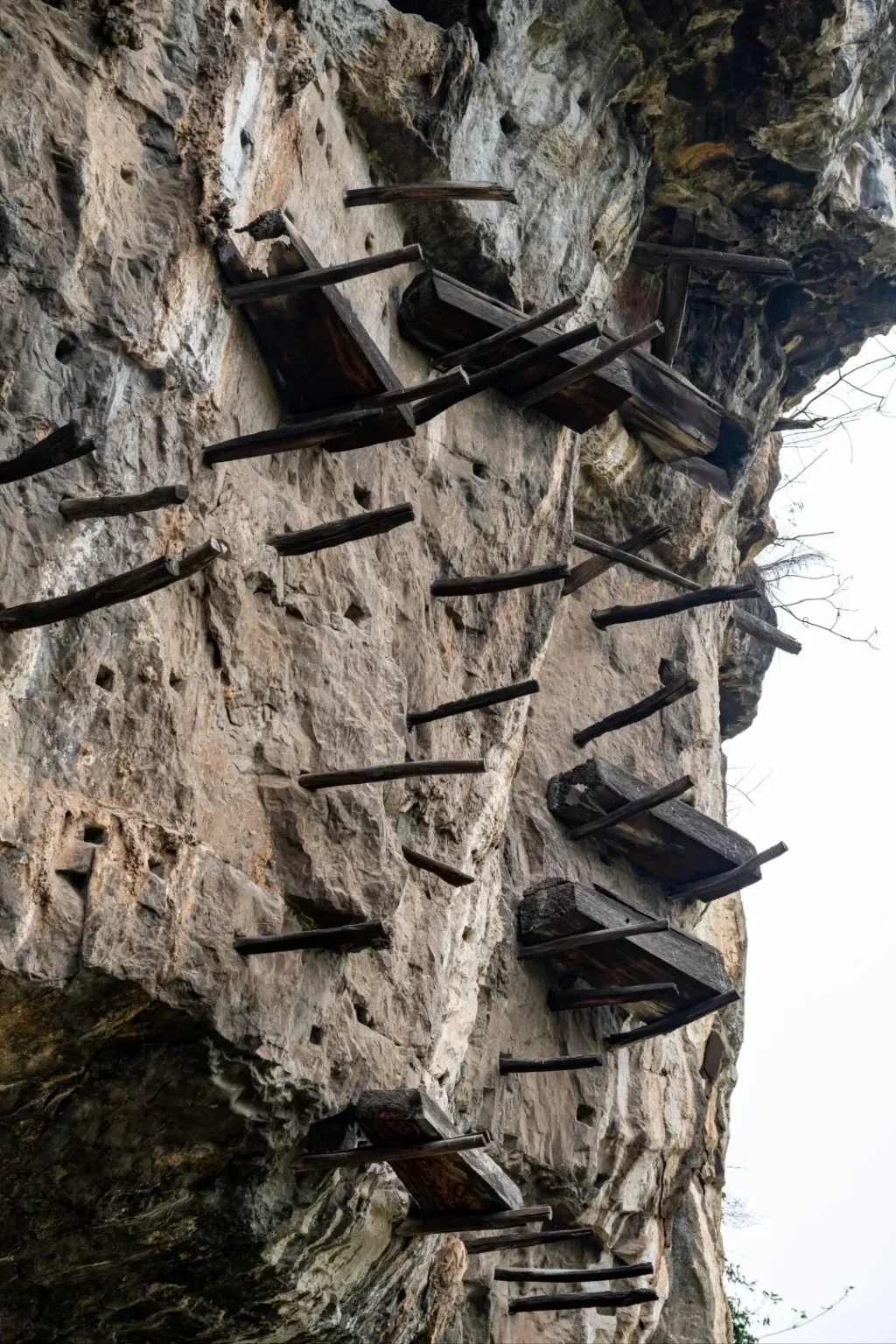
Numerous wooden coffins are precariously balanced on wooden beams projecting from a steep, rocky cliff face.

The ancient Bo people practiced the unique tradition of hanging their dead on cliff faces, a practice that still mystifies visitors to Gongxian.

Navigating the Journey: Chengdu to Luobiao

Reaching the coffins requires a multi-step journey, but modern infrastructure has made it significantly easier than it was a decade ago. Your journey starts in Chengdu, the capital of Sichuan.

Step 1: High-Speed Rail to Yibin

According to the official China Railway 12306 policy, foreign passports can be verified directly on the English version of the 12306 app. Book a high-speed train from Chengdu East Station to Yibin Station. The journey takes under 90 minutes and costs roughly ¥110 to ¥140 for a second-class seat. Expect the train stations to be massive and airport-like; arrive at least 45 minutes before departure.

Step 2: The Bus to Luobiao

From Yibin, take a taxi to the Yibin Nan’an Bus Station (宜宾南岸车站). Here, you need to purchase a ticket for the direct bus to Luobiao (洛表客运中心). These buses run three times a day, take roughly five hours, and navigate winding, bumpy mountain roads. The smell of diesel and damp earth is a constant companion on this route.

Step 3: Connectivity and Payments in Rural Sichuan

Once you leave Yibin, English signs vanish. You will absolutely need an active internet connection to use Alipay (the default payment method in China) and translation apps. I highly recommend installing a travel eSIM before you land to bypass the Great Firewall effortlessly.

💡 Editor’s Pick: We recommend Nomad eSIM for China because it reliably bypasses the Great Firewall with stable speeds.

With your eSIM active, you can seamlessly scan Alipay QR codes to pay for your bus tickets and local snacks, avoiding the hassle of breaking large ¥100 bills in rural villages.

The Reality of Visiting the Coffins (Insider Advice)

When you finally step off the bus in Luobiao, the air is noticeably cooler and thick with humidity. From the small Luobiao bus station, turn left. You have two options: a 45-minute walk along a dusty road, or a local motorcycle taxi.

Insider Tip: Take the motorcycle taxi. It costs exactly ¥30 (negotiate this before getting on), and saves your energy for climbing the stairs at the actual site. Arrange for the driver to pick you up two hours later, as finding a return ride from the remote cliffside can be incredibly difficult.

The Museum and the Main Cluster

Just inside the site entrance sits a small, unstaffed museum. It houses old photographs, burial artifacts, and a surprisingly intimate display of a coffin complete with a skeleton. There is no official entry fee, but it is customary to leave a small cash donation (¥10 or ¥20) near the coffin, just as the locals do.

About 100 meters further, the valley opens up, and you will see the largest cluster of coffins. The sheer scale is dizzying. If you stand quietly, the only sounds are the rustle of bamboo and the occasional creak of aging wood. Steps lead up to a massive cave offering a better vantage point. Be careful: the limestone steps are perpetually slick with moss and morning dew.

View from the opening of a large natural cave, looking out over a misty valley with terraced fields, small villages, greenhouses, and hills in the background. A person stands at the cave entrance with arms outstretched.

Standing at the mouth of a cave, the breathtaking vista of Gongxian unfolds, hinting at the ancient mysteries of the Bo people and their unique hanging coffins hidden within the surrounding cliffs.

What to Know Before You Go: An Overrated Detour

Many local guides will urge you to walk an additional 2 kilometers down the road to see a “second cluster” of coffins. Skip it if you are short on time. This second grouping is situated directly next to a noisy, active roadway, completely ruining the eerie, isolated atmosphere that makes the main cluster so special. Spend your time photographing the primary cliff face instead.

Practical Survival Tips for Luobiao

  • Hydration: Buy water in Luobiao town before heading to the site. A standard bottle of water costs ¥3 at the village store, but there are no vendors at the cliffs.
  • Facilities: Public restrooms at the site are traditional squat toilets and lack toilet paper or soap. Bring your own tissues and hand sanitizer.
  • Overnight Stays: Because the site is most photogenic at sunrise, consider arriving in Luobiao the evening before. There are basic guesthouses (nóngjiālè) in town for around ¥100 a night, though beds are notoriously hard, traditional Chinese style.


Common Questions About Traveling to China

How does the 144-hour visa-free transit policy work in China?

The 144-hour visa-free transit allows travelers from 54 eligible countries to enter China without a visa for up to six days. You must arrive at a designated port of entry, such as Chengdu Tianfu International Airport, and have a confirmed onward ticket to a third country.

Yes, a reliable internet connection is essential for using translation apps and payment platforms like Alipay. Purchasing a travel eSIM before you arrive is the easiest way to bypass the Great Firewall and maintain connectivity throughout your trip.

While most urban and rural areas rely heavily on digital payments like Alipay, it is wise to carry some cash. Small donations at historical sites or payments in very remote villages may occasionally require small denominations of Chinese Yuan.

In remote areas, public buses are common but can be infrequent and slow. For short distances between towns and tourist sites, local motorcycle taxis are often the most convenient option; just be sure to negotiate the fare before starting your journey.

Conclusion

Standing beneath the hanging coffins of the Bo people offers a rare, unfiltered glimpse into an ancient culture that history nearly forgot. While the journey from Chengdu requires patience, navigating local buses, and a willingness to step outside your comfort zone, the reward is a deeply atmospheric experience devoid of the massive tourist crowds found elsewhere in China. Ensure your Alipay is set up, your eSIM is activated, and your camera is ready for the morning mist. If you found this guide helpful, be sure to read our complete itinerary for exploring the hidden salt-trade relics of nearby Zigong.

Similar posts to this one

A display of traditional Chinese cheongsam dresses and jackets on mannequins and shelves. The garments feature various patterns like blue and white plaid, blue stripes, and subtle checkered fabrics. Some have mandarin collars and frog fastenings. A tote bag with a cat pattern hangs on the left, and a quilted fabric bag is also visible.

Beyond the Silk Road: A Practical Guide to Custom Cheongsam in Suzhou

For centuries, the misty canal city of Suzhou has been the undisputed capital of Chinese silk. If you are traveling [...]

A woman wearing a black beret and jacket walks away from the camera through a narrow alleyway lined with numerous colorful oil paintings displayed on easels and walls. A black camera hangs from her hand. The paintings vary in size and style, featuring portraits, abstract designs, and detailed scenes. Some paintings are on wooden stands in the foreground, while others are hung higher up on the building's facade. The alley floor is concrete with painted graffiti and a manhole cover. An air conditioning unit is visible on the building to the left.

Art on a Budget: A Practical Guide to Shenzhen's Dafen Oil Painting Village

Stepping into the labyrinth of alleys in Shenzhen's Longgang District, the thick, earthy scent of linseed oil and turpentine immediately [...]

An aerial view of an ancient stone village complex built on the side of a steep, forested mountain. The architecture features grey tiled roofs, stone walls, and courtyards, with narrow staircases and patios clinging to the cliff face. Lush green trees surround the structures.

Anshun Beyond the Falls: Exploring Guizhou's Ancient Tunpu Villages

If you are piecing together your China itinerary, you need a reliable Anshun travel guide that looks beyond the obvious. [...]

Get the China Arrival Survival Kit

Planning a trip here has a steep learning curve. Join our newsletter and receive our free “Day One Checklist” covering everything from setting up Alipay and WeChat to bypassing the internet firewall.