


What is the 144-Hour Visa-Free Transit?
The 144-hour visa-free transit policy allows citizens of 54 eligible countries to explore Guangdong Province for up to six days without a prior visa. You must enter via eligible ports, like Guangzhou Baiyun International Airport, and possess a confirmed onward flight ticket to a third country or region.
How to Get to Kaiping from Guangzhou
Navigating rural Guangdong is much easier than it was a decade ago, thanks to China’s expanding rail network. You will start your journey at the massive Guangzhou South Railway Station.
According to the official 12306 China Railway policy for 2026, foreign travelers can easily book high-speed rail tickets online using their passport number. The train to Kaipingnan (Kaiping South) takes about 60 minutes. E-tickets are standard; simply scan your physical passport at the automated turnstiles to board.
Once you arrive at Kaipingnan, you will need reliable internet to hail a ride. Buying a local SIM card can be a bureaucratic nightmare. I highly recommend downloading an eSIM before you land.
💡 Editor’s Pick: We recommend Nomad eSIM for China because it reliably bypasses the Great Firewall with stable speeds.
With your connection secured, use the Didi mini-program inside WeChat or Alipay to hail a car to Tangkou Town (塘口镇). The 30-minute ride costs around 40 RMB. While local public buses (like Bus 617) do run between the station and the villages, they are infrequent and lack English signage.
Navigating the Diaolou Clusters: Where to Go (and What to Skip)
The Kaiping Diaolou are not located in a single park; they are scattered across several working farming villages. The 180 RMB combo ticket (purchasable via QR code at any village entrance) is your best value.
Zili Village: The Cinematic Icon
If you only have time for one stop, make it Zili Village (自力村). This cluster features 15 remarkably preserved towers rising dramatically from lotus ponds and rice paddies. You will immediately recognize Mingshi Lou (铭石楼), the striking watchtower made famous by the 2010 film Let the Bullets Fly.
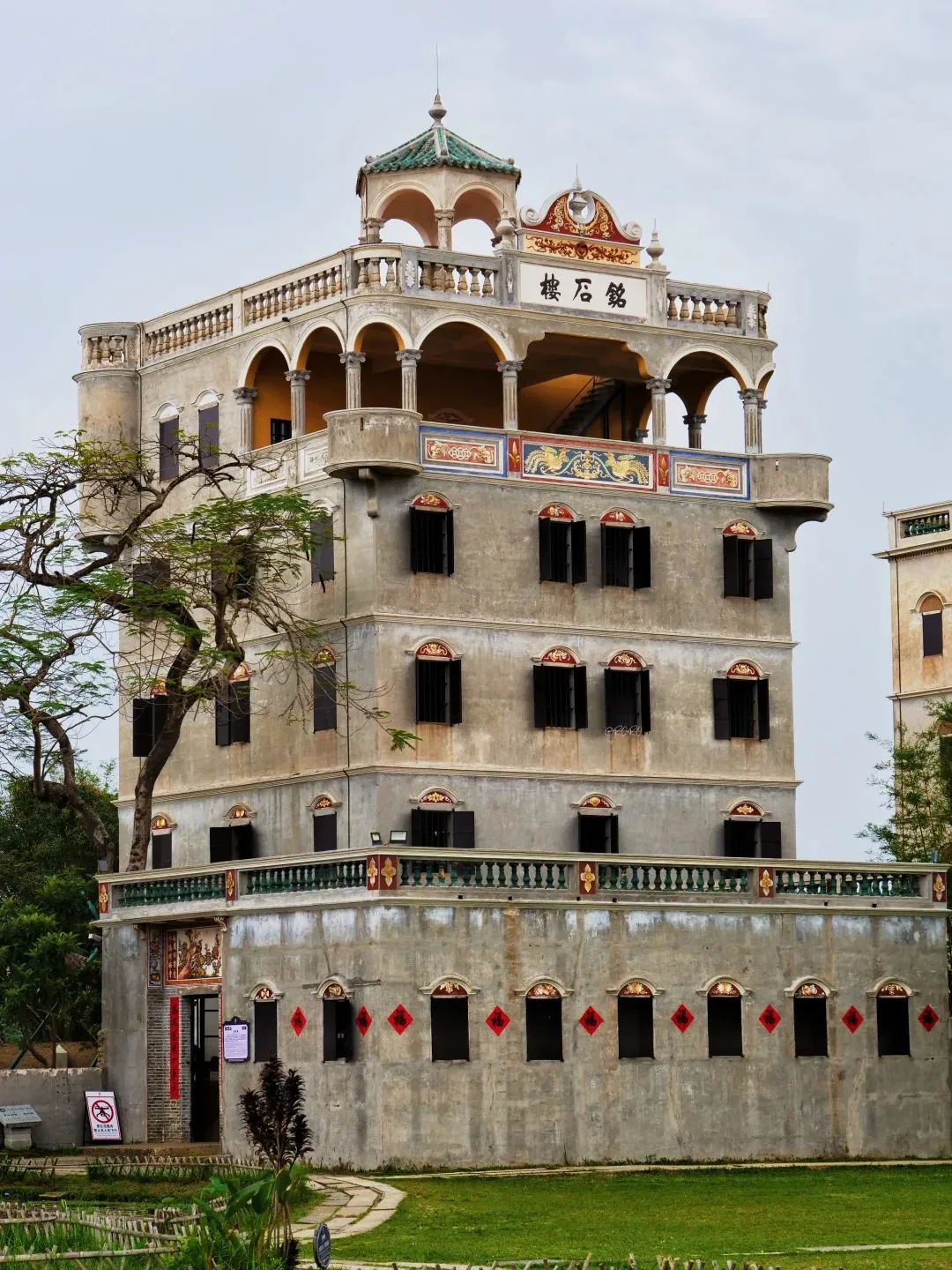
The Mingshi Lou in Zili Village is a striking example of the unique Kaiping Diaolou, watchtowers built by overseas Chinese. This structure showcases the blend of architectural styles that make these UNESCO World Heritage sites so fascinating.
Insider Tip: Do not underestimate the brutal Guangdong humidity, which often pushes the heat index above 35°C (95°F) from May to September. You will smell the earthy dampness of the paddies and the smoke of mosquito coils burning in local shops. Buy a cold bottle of mineral water for 5 RMB from a village vendor before climbing the narrow, sweltering staircases of the towers.
Jinjiangli: The Architectural Masterpiece
Located about 20 kilometers southwest of Kaiping city, Jinjiangli (锦江里) is much quieter than Zili. This sleepy village is home to Ruishi Lou (瑞石楼), the tallest surviving diaolou in the region.

The Ruishi Lou, one of the most iconic Kaiping Diaolou, stands as a testament to the unique architectural fusion found in Guangdong’s watchtowers, blending Chinese and Western influences.
Built in 1923, this nine-story marvel features a bizarre but beautiful mix of Byzantine roofs and Roman arches. Because it is still privately owned, your combo ticket does not cover entry. You must knock on the caretaker’s door and transfer an extra 20 RMB via WeChat to climb to the top. The panoramic view of the Tanjiang River from the roof is entirely worth the fee.
Is Li Garden Worth It?
Many tours push Li Garden (立园), a fortified 1936 mansion built by a Chinese-American businessman. While the Italianate floor tiles and artificial canals are pretty, it feels distinctly manicured and touristy compared to the rugged authenticity of the village watchtowers. If you are short on time, skip Li Garden and spend an extra hour wandering the quiet, overgrown alleyways of Majianglong (马降龙) instead.
Photography and Timing: When to Visit
The best time of year to visit Kaiping is between late October and early December. The weather is dry, the skies are clear, and the rice paddies turn a brilliant golden yellow just before the autumn harvest.
If you are serious about photography, avoid arriving at noon when the harsh overhead sun washes out the intricate stonework of the towers. Instead, time your visit to Zili Village for golden hour (around 4:00 PM to 5:30 PM). The fading light casts long shadows across the fields and illuminates the baroque facades of the diaolou perfectly.
Final Thoughts on Exploring Kaiping
Visiting the Kaiping Diaolou requires a bit more logistical effort than taking a standard city tour, but the reward is one of China’s most surreal and uncrowded historical landscapes. By utilizing high-speed rail, setting up your digital payment apps in advance, and knowing exactly which villages to target, you can easily experience this architectural marvel in a single, well-planned day.