
Beyond Pandas: A Guide to Hiking Sichuan's Shunan Bamboo Sea

Most foreign visitors arrive in Chengdu, snap a few photos of the giant pandas, eat a bowl of fiery mapo tofu, and promptly fly out. But if you want to experience the misty, cinematic landscapes that inspired Crouching Tiger, Hidden Dragon, you need to head south. Incorporating Sichuan bamboo forest travel into your itinerary reveals a completely different side of the province.

The Shunan Bamboo Sea (Shunan Zhuhai National Park) is a sprawling, 120-square-kilometer ocean of towering green stalks. Navigating this remote park in 2026 requires a bit of logistical savvy, but the reward is hiking through deeply quiet, emerald-lit valleys far from the chaotic tourist hubs.

TL;DR: Trip Essentials

  • Getting There: Take a 1.5-hour high-speed train from Chengdu East to Yibin (approx. ¥107), then a local bus to the park’s West Gate at Wanling.
  • Entry Cost: Official 2026 park admission is ¥110 (January-November) and ¥60 in December.
  • Best Navigation: Use the Guanguang cable car (¥40 return) to skip the steepest climbs and access the best ridge trails.
  • Connectivity: Buy an eSIM before arriving; foreign credit cards require Alipay or WeChat integration to pay for food, transport, and tickets.

Summarize with :

How to Navigate from Chengdu to the Bamboo Sea

Getting to the park is a multi-step journey, but China’s rapidly expanding infrastructure makes it highly manageable. You will start by heading to Chengdu East Railway Station.

According to the official 12306 rail policy, high-speed trains from Chengdu to Yibin run roughly 15 times daily. The journey takes just 90 minutes. Once you arrive at Yibin Station, ignore the aggressive private taxi touts near the exit.

Instead, follow the bilingual signs to the adjacent bus terminal. Here, you can catch a direct shuttle to Wanling (the West Gate of the Bamboo Sea) for about ¥22. The bus ride takes roughly two hours, winding through increasingly rural, terraced landscapes.

Solving the Connectivity Problem

You will need reliable internet the moment you step off the plane in Chengdu. From scanning QR codes for your bus tickets to translating menus in rural Yibin, a solid data connection is non-negotiable. Because the Great Firewall blocks Google Maps and WhatsApp, you need a reliable workaround.

💡 Editor’s Pick: We recommend Nomad eSIM for China because it reliably bypasses the Great Firewall with stable speeds. Use code JORICAQLKF at checkout to get $5 USD off your first data plan.

Setting up your eSIM before you land ensures your Alipay and WeChat apps function immediately. Cash is practically obsolete in this region; even the elderly women selling roasted sweet potatoes at the park entrance only accept digital payments.

What is the 144-Hour Transit Visa?

The 144-hour visa-free transit policy allows citizens from 54 eligible countries to explore specific Chinese regions, including Sichuan province via Chengdu Tianfu International Airport, for up to six days without a pre-approved tourist visa, provided they hold a valid onward ticket to a third country.

A serene river flows through a dense bamboo forest. Tall, arching bamboo stalks form a natural canopy overhead. The river features several small, stepped waterfalls and moss-covered rocks in the foreground. Beams of sunlight pierce through the distant misty foliage.

Beyond just a view, hiking through Sichuan’s Shunan Bamboo Sea reveals countless moments of natural splendor, like these tranquil cascades bathed in morning light.

Hiking the Emerald Forest: Trails and Cable Cars

Once inside the park, the sensory shift is immediate. The air is incredibly humid, carrying the distinct, earthy scent of damp moss and fast-growing grass. It is eerily quiet, save for the wind rustling the canopy and the creak of bamboo stalks rubbing against one another.

The park is vast and optimized for domestic driving tours, but the central interconnected trails are perfect for hikers. Start by taking the Guanguang Cable Car. For ¥30 one-way, this 25-minute ride glides directly over the dense forest canopy, offering a spectacular bird’s-eye view.

From the top station, you can hike the paved, one-hour loop along Mo Brook. The path is well-maintained, but the stone steps become incredibly slick after the frequent afternoon drizzles. Wear shoes with aggressive traction.

What to Know Before You Go: The “Sea within the Sea” Trap

If you look at local tourist maps, they heavily promote a lake called the “Sea within the Sea” (Haizhonghai). Skip it. It is a massive bottleneck where domestic tour groups congregate with loud megaphones to take overpriced bamboo raft rides.

Instead, spend your time hiking the Forgotten Worries Valley (Wangchen Gu) near Wanling village. It is a serene, two-hour out-and-back trail that winds past a series of progressively larger waterfalls. You will likely have the misty, narrow gorge entirely to yourself.

A Culinary Deep Dive: Eating the Bamboo Sea

You cannot visit Shunan without indulging in the local “Panda Banquet”—a feast where nearly every dish features bamboo. The food here is intensely flavorful, relying heavily on smoked meats and wild-foraged ingredients rather than the numbing peppercorns found in Chengdu.
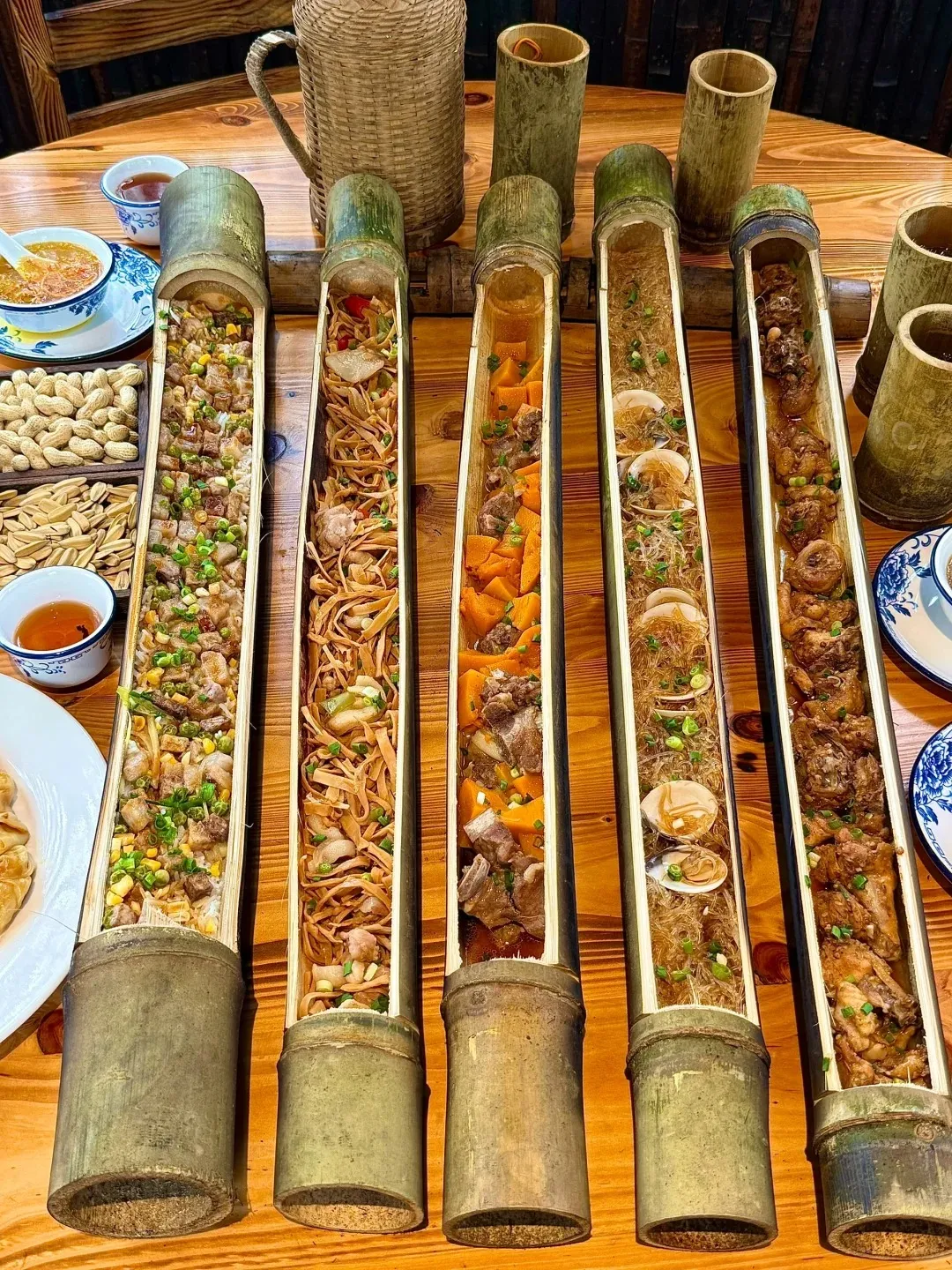
Five long bamboo tubes display a variety of steaming Sichuan dishes on a wooden table: rice with pork, corn, and green onions; stir-fried bamboo shoots with meat; pumpkin and pork ribs; glass noodles with clams; and braised chicken. A bamboo pitcher, small bamboo cups, a bowl of soup, peanuts, sunflower seeds, and tea are also visible.

Beyond the stunning landscapes of Sichuan’s Shunan Bamboo Sea, hiking also rewards you with a taste of its unique culinary traditions. Many local guesthouses honor the region’s star plant by serving a variety of dishes, from flavorful rice to savory stews, all cooked and presented within fresh bamboo tubes.

Be sure to order Zhusun (Bamboo Fungus). This delicate, lacy mushroom grows exclusively on the roots of dead bamboo and is usually served in a rich, savory chicken broth. It has a satisfying, sponge-like crunch.

For a cheap, high-energy hiking snack, look for vendors selling Zhoutong Fan (Bamboo Tube Rice). Sticky rice, local preserved pork, and peanuts are stuffed into a hollow bamboo section and steamed over an open fire. It costs about ¥15 and absorbs the sweet, woody aroma of the stalk.

Practical Logistics for Your 2026 Visit

While the park is stunning, you need to manage your expectations regarding amenities. This is rural Sichuan. A bottle of water at a trailside kiosk will cost you ¥5 (double the city price), and western toilets are virtually non-existent once you leave your hotel.

Base yourself in Wanling Village at the West Gate. Family-run guesthouses here offer basic, clean rooms for around ¥150 to ¥200 per night. They are accustomed to foreign travelers and can help arrange cheap motorbike taxis (around ¥60) to transport you between trailheads if your legs give out.

Finally, pack layers. Even in the sweltering heat of a Sichuan summer, the dense canopy blocks the sun, and the deep valleys can feel surprisingly chilly by late afternoon.


Common Questions About China Travel & Shunan

How do I get to the Shunan Bamboo Sea from Chengdu?

Take a 90-minute high-speed train from Chengdu East Railway Station to Yibin. From the adjacent Yibin bus terminal, catch a direct shuttle bus to Wanling, which serves as the West Gate of the park. The full journey takes roughly three and a half hours.

Cash and foreign credit cards are practically obsolete in China, even in rural areas like the Shunan Bamboo Sea. You will need to set up digital payment apps like Alipay or WeChat Pay before your trip. Purchasing a reliable eSIM is highly recommended to ensure these apps work seamlessly upon arrival.

The 144-hour visa-free transit policy allows citizens from 54 eligible countries to explore the Sichuan province for up to six days without a pre-approved tourist visa. To qualify, you must enter through Chengdu Tianfu International Airport and hold a valid, confirmed onward ticket to a third country.

You should try the local ‘Panda Banquet,’ an intensely flavorful feast featuring wild-foraged bamboo ingredients. Standout dishes include Zhusun (Bamboo Fungus) served in a rich chicken broth, and Zhoutong Fan, which is sticky rice and preserved pork steamed inside a hollow bamboo tube.

Escaping the crowds of Chengdu to hike the Shunan Bamboo Sea requires a bit of extra effort, but it delivers an authentic, deeply atmospheric slice of rural China. If you are ready to explore beyond the panda reserves, book your high-speed train tickets, secure your eSIM, and prepare to get lost in the emerald expanse. For more off-the-beaten-path itineraries, check out our complete guide to exploring Western Sichuan’s Tibetan plateau.

Similar posts to this one

A colossal statue of the seated Buddha carved into a red sandstone cliff face, overlooking a wide, green river. The statue is immense, with visible details of its serene face, folded hands, and large feet resting on a platform. Lush green trees and foliage grow along the top and sides of the cliff. A small white boat with a few people on board is visible in the river in the foreground.

Leshan and Mount Emei in 3 Days: Temples, Trails and Hot Springs

Escaping the urban sprawl of Chengdu for the misty peaks of Sichuan province is a rite of passage for any [...]

A person in a light jacket and straw hat descends a steep, mossy stone staircase with concrete railings. In the background, towering, mist-shrouded green cliffs rise above a winding river with several small boats, and a red-roofed traditional pavilion is visible among the trees.

Hiking the Wuyi Mountains: A Guide to Tea, Temples, and River Rafting

Finding a reliable Wuyishan travel guide can be frustrating, as many resources gloss over the logistical realities of navigating this [...]

Numerous colorful camping tents are set up on a green grassy hillside next to a long, winding section of the Great Wall. The ancient stone wall extends up a steep hill to a stone watchtower on the summit, all under a clear blue sky with distant mountains in the background. A few people are visible near the tents.

A Guide to 'Wild' Great Wall Camping: Safety, Gear, and Top Locations

Most travelers experience the Great Wall shoulder-to-shoulder with thousands of others at restored sections like Badaling. But if you're looking [...]

Get the China Arrival Survival Kit

Planning a trip here has a steep learning curve. Join our newsletter and receive our free “Day One Checklist” covering everything from setting up Alipay and WeChat to bypassing the internet firewall.