
Discovering Qingdao: Beer Street, Coastal Walks & Hidden German Architecture

Stepping off the high-speed train into the salty, humid air of the Shandong peninsula, you immediately realize this is not your typical Chinese megacity. Discovering Qingdao: Beer Street, Coastal Walks & Hidden German Architecture reveals a coastal haven where European history and modern Chinese culture collide. Here, the aroma of spicy stir-fried clams mingles with the sea breeze, and locals carry home fresh, unpasteurized draft beer in clear plastic bags.

For a first-time traveler, navigating this sprawling port city can feel overwhelming. This guide cuts through the noise, offering actionable, walkable routes to help you experience the very best of Qingdao’s Bavarian-tinged streets, pristine coastlines, and legendary culinary scene.

Quick Summary: Key Takeaways for Your Trip

  • Ideal Trip Length: Plan for 2 to 3 full days to explore the historic German district, tour the Tsingtao Brewery, and walk the coastal boardwalks without rushing.
  • Best Time to Visit: Target May to June or September to October. July and August bring heavy domestic crowds, intense humidity, and occasional blue-green algae blooms on the beaches.
  • Must-Try Experience: Drinking cold, unpasteurized Tsingtao yuanjiang served in a plastic bag on Beer Street, paired with local mackerel dumplings.
  • Navigation Essentials: Download Alipay and WeChat for all mobile payments. Use the built-in Didi mini-app for ride-hailing, or rely on the highly efficient Qingdao Metro network.

Summarize with :

Pre-Trip Logistics: Visas, Trains, and Connectivity

Before you can wander the cobblestone streets of the old German concession, you need to get your logistics sorted. As of 2026, traveling through China is heavily reliant on digital infrastructure, so preparation is non-negotiable.

What is the 144-hour visa-free transit?

The 144-hour visa-free transit policy allows citizens of 54 eligible countries to explore Qingdao and the wider Shandong province without a pre-approved Chinese visa for up to six days. You must have a confirmed onward flight to a third country outside of mainland China to qualify.

If you are arriving by train from Beijing or Shanghai, you will need to book your tickets in advance. According to the official China Railway 12306 policy, foreign passports can now be verified online instantly. Simply download the 12306 app, upload your passport page, and your ticket will be linked digitally to your document.

To navigate the city, use maps, and pay for your seafood, a reliable internet connection that bypasses the Great Firewall is essential. We highly recommend installing an eSIM before your plane lands.

💡 Editor’s Pick: We recommend Nomad eSIM for China because it reliably bypasses the Great Firewall with stable speeds.

Strolling the Old Concession: Hidden German Architecture

Germany controlled Qingdao from 1897 to 1914, and their architectural legacy remains remarkably intact. The Old Town (Shinan District) is a walkable enclave of red-roofed villas, steep hills, and unexpected European charm.

Aerial view of a large European-style cathedral with red-tiled roofs and twin towers, situated in a bustling public square in Qingdao. The square is surrounded by buildings with similar red-tiled roofs and European architectural influences. In the background, a modern cityscape with tall skyscrapers and a body of water can be seen.

The magnificent St. Michael’s Cathedral stands as a testament to Qingdao’s rich German architectural heritage, a key highlight of exploring the city’s historic Old Town.

Start your morning at the Former German Governor’s House. Built in 1905, this Wilhelmian-style mansion feels entirely out of place in East Asia. The entrance fee is 20 RMB, and exploring the lavishly restored interior offers a fascinating glimpse into Qingdao’s colonial past.

From there, wind your way down the leafy, cobbled streets toward St. Michael’s Cathedral. The twin-spired Romanesque church dominates the skyline. The surrounding plaza is almost always packed with couples taking wedding photos, creating a lively, chaotic atmosphere.

What to Know Before You Go: The Zhanqiao Pier Trap

Many guidebooks push Zhanqiao Pier as a must-see landmark. In reality, by 9:00 AM, this narrow strip of concrete is shoulder-to-shoulder with tour groups wielding selfie sticks. If you want a peaceful view of the Huilan Pavilion, arrive by 6:30 AM.

Alternatively, skip the pier entirely and hike up to Little Fish Hill Park (Xiaoyushan). For a mere 10 RMB, a five-minute climb rewards you with the absolute best 360-degree view of the city’s red rooftops contrasting against the blue sea.

Planning the Perfect Coastal Boardwalk Day

Qingdao’s coastline is its greatest asset. A dedicated pedestrian boardwalk hugs the rocky shore, making it incredibly easy to spend a full day walking along the Yellow Sea.

Begin at No. 1 Bathing Beach. While it gets overwhelmingly crowded in mid-summer (often likened to a pot of boiling dumplings), the shoulder seasons offer a peaceful stretch of butterscotch-hued sand. Walk eastward along the promenade toward Lu Xun Park, where the path weaves through red coastal rocks and pine trees.

If you want a more modern coastal vibe, take the metro to Xiaomaidao Park. This small, grassy island connected by a causeway is a favorite among young locals. The sea breeze is intense here, and the crashing waves against the southern lighthouse make for spectacular photography.

Tasting Qingdao: Beer Street and Fresh Seafood

You cannot visit Qingdao without paying homage to its most famous export. The Tsingtao Beer Museum, located in the original 1903 brewery, is part history lesson and part drinking spree.
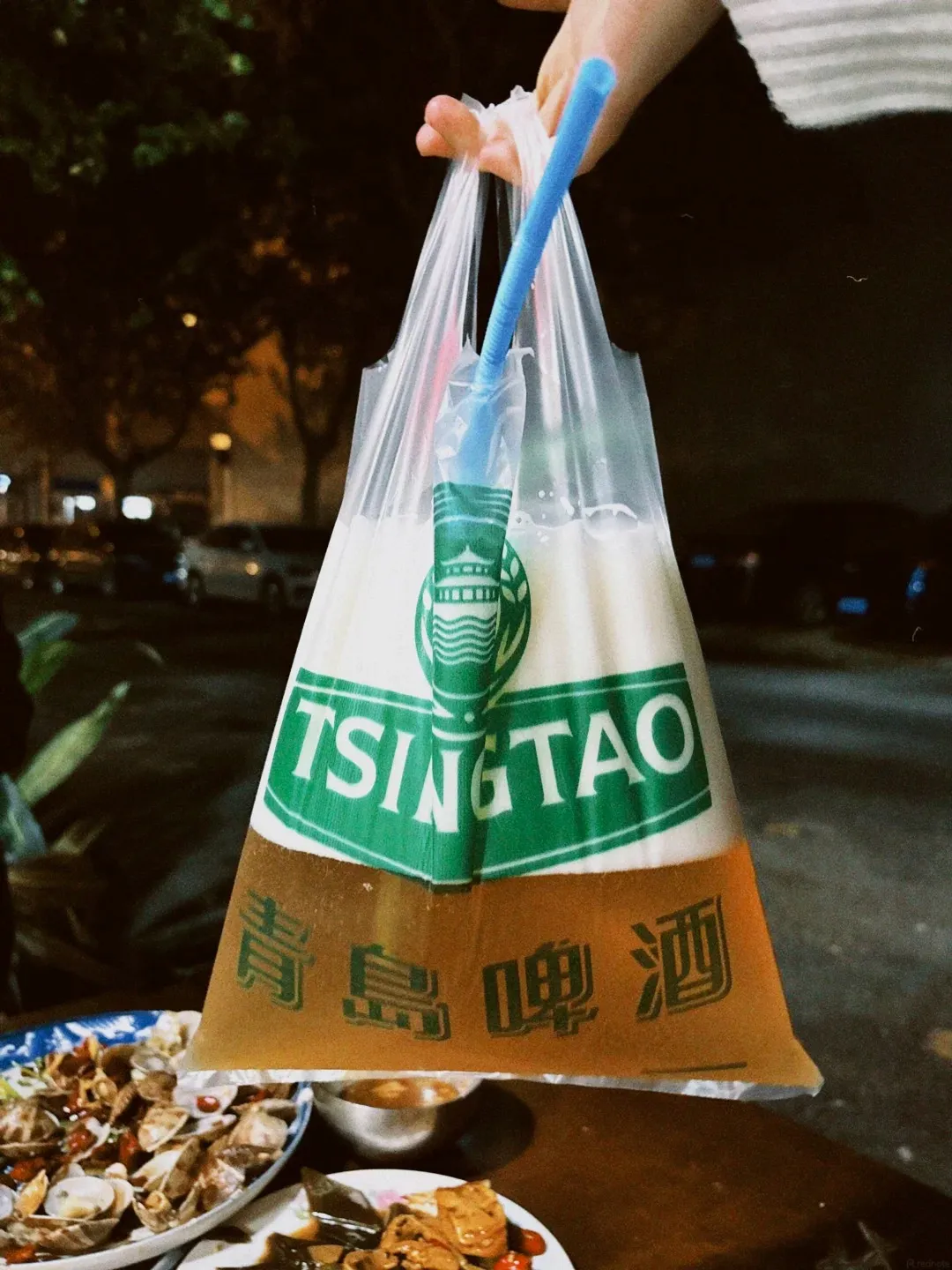
A person holds a clear plastic bag filled with Tsingtao beer, with a blue straw inserted. The bag is transparent, showing a lighter frothy liquid at the top and darker golden beer at the bottom. A green band with white text 'TSINGTAO' is visible on the bag, above Chinese characters. In the foreground, out of focus, are plates of food, including clams and other dishes, on a wooden table. The background is dark, suggesting an outdoor evening setting with trees and streetlights.

Fueling our Qingdao adventure on Beer Street! Nothing beats a fresh bag of Tsingtao draft beer to accompany the night market’s incredible seafood.

Do not buy the basic 60 RMB entry ticket. Instead, upgrade to the 95 RMB tasting ticket. This grants you generous pours of various brews along the tour route, including the coveted unfiltered stout and the crisp, cloudy IPA.

After the museum, walk outside to Beer Street (Pijiu Jie). Here, you will encounter Qingdao’s most unique cultural quirk: bagged beer. Kegs of yuanjiang (unpasteurized beer) line the sidewalks. Vendors pour the cold, cloudy liquid directly into clear plastic bags, weighed by the jin (500g), and hand it to you with a straw.

Insider Tip: Where to Eat Seafood

Avoid Pichai Yuan food street on Zhongshan Road. While historic, it has devolved into an overpriced tourist trap notorious for aggressive touts and mediocre seafood.

Instead, head to local chains like Kai Hai (开海) or Chuan Ge Yu Shui Jiao (船歌鱼水饺). You must order the city’s signature dishes: spicy stir-fried clams (perfectly paired with cold beer) and mackerel dumplings. The dumplings are a Shandong specialty, featuring delicate wrappers stuffed with a savory, ginger-infused fish filling.


Common Questions About Traveling to China

What is the 144-hour visa-free transit policy for China?

This policy allows citizens from 54 eligible countries to visit specific Chinese regions, including Shandong province, for up to six days without a visa. To qualify, you must have a confirmed onward flight to a third country outside of mainland China.

China is a highly digital economy. You should download and set up Alipay and WeChat Pay before you arrive, as these are the primary methods for everything from street food to transport. Link your international credit card to these apps for seamless transactions.

Yes, a reliable internet connection is crucial for accessing maps and payment apps. An eSIM is highly recommended as it allows you to bypass the Great Firewall and maintain connectivity immediately upon landing.

You can now use the official China Railway 12306 app to book tickets. The app allows you to verify your foreign passport online and links your tickets digitally to your document for easy boarding.

Conclusion: How Many Days Do You Need?

To truly appreciate the blend of colonial history, coastal scenery, and culinary delights, you should dedicate at least two to three full days to Qingdao. This gives you ample time to explore the old German concession on day one, hike Laoshan Mountain or walk the coastal boardwalks on day two, and indulge in the Tsingtao Beer Museum and seafood markets on day three.

If you are ready to explore the “Green Island” of China, make sure your mobile payments are set up, your eSIM is activated, and your appetite for fresh seafood is ready. Book your high-speed train tickets today, and check out our comprehensive guide to navigating China’s railway system for a seamless journey.

Similar posts to this one

The upper levels of the Yellow Crane Tower, a traditional Chinese multi-tiered pavilion with orange tiled roofs and red painted columns, are visible against a clear blue sky. Green foliage from trees and branches frame the lower and left sides of the image. A black plaque with Chinese characters is mounted on the central structure.

Wuhan 48-Hour Weekend Guide: Hot Dry Noodles & Yangtze Views

Wuhan is a city that runs on high-octane energy, fueled by rich sesame paste and the relentless current of the [...]

An aerial view of a busy Guangzhou night market at night, with numerous illuminated street food stalls lining a street. People are seen walking, eating, and interacting at the stalls, with trees and lights overhead. Some stalls have colorful signs and displays of food, while others are equipped with cooking equipment. Small tables and chairs are set up for diners. Several motorized carts, including a blue three-wheeled vendor vehicle, are also present on the street.

Guangzhou's Best Night Markets: A Guide to Evening Street Food and Local Life

The humid evening air in southern China carries an unmistakable scent: a mix of sizzling garlic, sweet soy sauce, and [...]

A person wearing a hat and plaid shirt stands on a walkway in front of a traditional multi-tiered pagoda with a modern blue glass skyscraper behind it. A red wooden railing runs along the walkway in the foreground.

Chaozhou Street Food Guide: Best Markets and Local Snacks

Chaozhou (often known as Teochew) is a legendary culinary destination in Guangdong province, recognized by UNESCO as a City of [...]

Get the China Arrival Survival Kit

Planning a trip here has a steep learning curve. Join our newsletter and receive our free “Day One Checklist” covering everything from setting up Alipay and WeChat to bypassing the internet firewall.