
Beijing Central Axis: A DIY Walking Guide to the UNESCO World Heritage Site

Planning a trip to China in 2026? Tackling the newly minted UNESCO World Heritage site requires a solid Beijing Central Axis walking guide. Spanning 7.8 kilometers from south to north, this invisible line dictates the symmetrical layout of the ancient capital, cutting straight through its most iconic imperial monuments and bustling historic neighborhoods.

Walking the Zhongzhouxian (Central Axis) is the ultimate way to understand Beijing’s divine geometry. However, navigating the sprawling plazas, complex ticketing systems, and intense security checkpoints requires serious preparation. This guide provides the exact logistics you need to conquer the historical backbone of the Middle Kingdom.

TL;DR: Trip Essentials

  • Distance & Time: The axis spans nearly 8 kilometers. Plan for a grueling 8-10 hour day, or ideally, split the itinerary into two days to avoid severe foot fatigue.
  • Forbidden City Tickets: You must book exactly 7 days in advance at 8:00 PM Beijing time via the official WeChat Mini Program; tickets routinely sell out within three minutes.
  • Payments: Physical cash is rarely accepted in 2026. You must download Alipay and link your foreign Visa or Mastercard before landing in China.
  • Security Checks: Carry your physical passport everywhere. You will need it to pass the multiple facial-recognition security checkpoints surrounding Tiananmen Square.

Summarize with :

What is the 144-hour visa-free transit?

The 144-hour visa-free transit is a Chinese immigration policy allowing citizens of 54 eligible countries to explore Beijing and the surrounding Jing-Jin-Ji region for up to six days without a pre-approved visa, provided they hold valid travel documents and a confirmed onward flight to a third country.

Essential Logistics: Connectivity, Payments, and Tickets

Bypassing the Great Firewall

Do not rely on your home country’s roaming plan, and avoid the hassle of buying a physical SIM card at the Beijing Capital Airport arrivals hall. To use essential navigation and translation apps, you need a reliable eSIM that automatically routes your data around China’s internet restrictions.

💡 Editor’s Pick: We recommend Nomad eSIM for China because it reliably bypasses the Great Firewall with stable speeds.

Once connected, download Amap (Gaode Ditu) or Apple Maps, as Google Maps is highly inaccurate in Beijing due to GPS shift restrictions. WeChat and Alipay are mandatory for scanning QR codes at restaurants and subway turnstiles.

Booking the Big Sights

According to the official Palace Museum policy, walk-up ticket sales do not exist. Everything is digitized. You must use the “Palace Museum” (故宫博物院) WeChat Mini Program. Set an alarm for exactly 8:00 PM Beijing time, one week before your planned visit. Have your passport details pre-typed in your notes app to copy and paste rapidly.

Other sites along the axis, like the Temple of Heaven and Jingshan Park, also require advance booking via WeChat, though usually just 1-2 days prior is sufficient.

The Walking Route: South to North
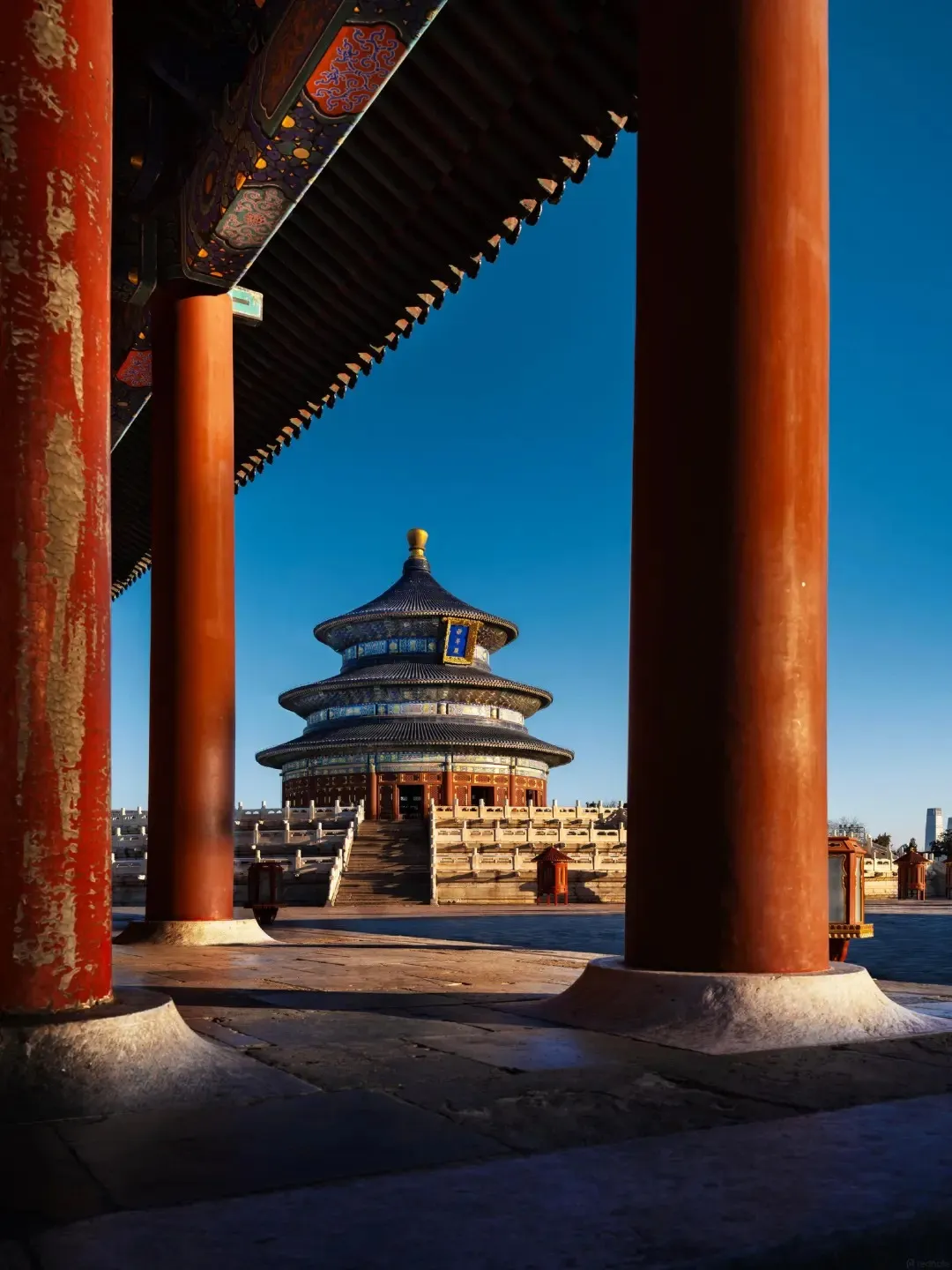
Framed by two large red pillars in the foreground and a shadowed wooden eave overhead, the triple-eaved Hall of Prayer for Good Harvests at the Temple of Heaven in Beijing is visible under a clear blue sky. The circular building has a dark blue tiled roof topped with a golden finial. It sits on a multi-tiered white marble terrace with stone balustrades and stairs leading up to its entrance. Several smaller red lanterns are placed around the terrace.

The Hall of Prayer for Good Harvests, a stunning centerpiece of the Temple of Heaven, stands majestically along Beijing’s Central Axis. Discover its beauty and history with our DIY walking guide.

Stop 1: Yongdingmen Gate & The Temple of Heaven

Start your morning at Yongdingmen Gate, the reconstructed southern terminus of the axis. From here, walk north toward the Temple of Heaven. Enter through the South Gate to follow the traditional imperial procession route.

You will walk along the 360-meter-long Danbi Bridge toward the Hall of Prayer for Good Harvests. The sheer scale of this mortarless, triple-eaved wooden structure is staggering. Arrive by 8:00 AM to watch local Beijingers practicing Tai Chi and ballroom dancing in the surrounding cypress groves.

Stop 2: Qianmen Street and Dashilar

Continuing north, you will hit Qianmen Dajie. This pedestrian street was rebuilt for the 2008 Olympics and feels a bit like a commercialized movie set. Insider Tip: Skip the main avenue. Instead, duck into the narrow alleys of Dashilar and Yangmeizhu Xiejie to the west.

Here, the sensory details of old Beijing come alive. You’ll catch the pungent, fermented scent of douzhi (mung bean milk) and hear the sizzle of lamb skewers. Grab a cold, glass bottle of Arctic Ocean (Beibingyang) orange soda for about ¥6 from a corner vendor to combat the midday heat.

Stop 3: Tiananmen Square & The Forbidden City

Crossing into Tiananmen Square requires passing through strict security cordons. Have your passport ready. The blistering summer heat radiating off the vast concrete paving stones can be intense, so bring an umbrella for shade.

Pass under the iconic portrait of Chairman Mao at the Gate of Heavenly Peace to enter the Forbidden City. Follow the central axis directly through the Meridian Gate, the Hall of Supreme Harmony, and the Imperial Garden. The 9,999 rooms are overwhelming, but staying strictly on the central stone path keeps you aligned with the emperor’s historical trajectory.

Stop 4: Jingshan Park
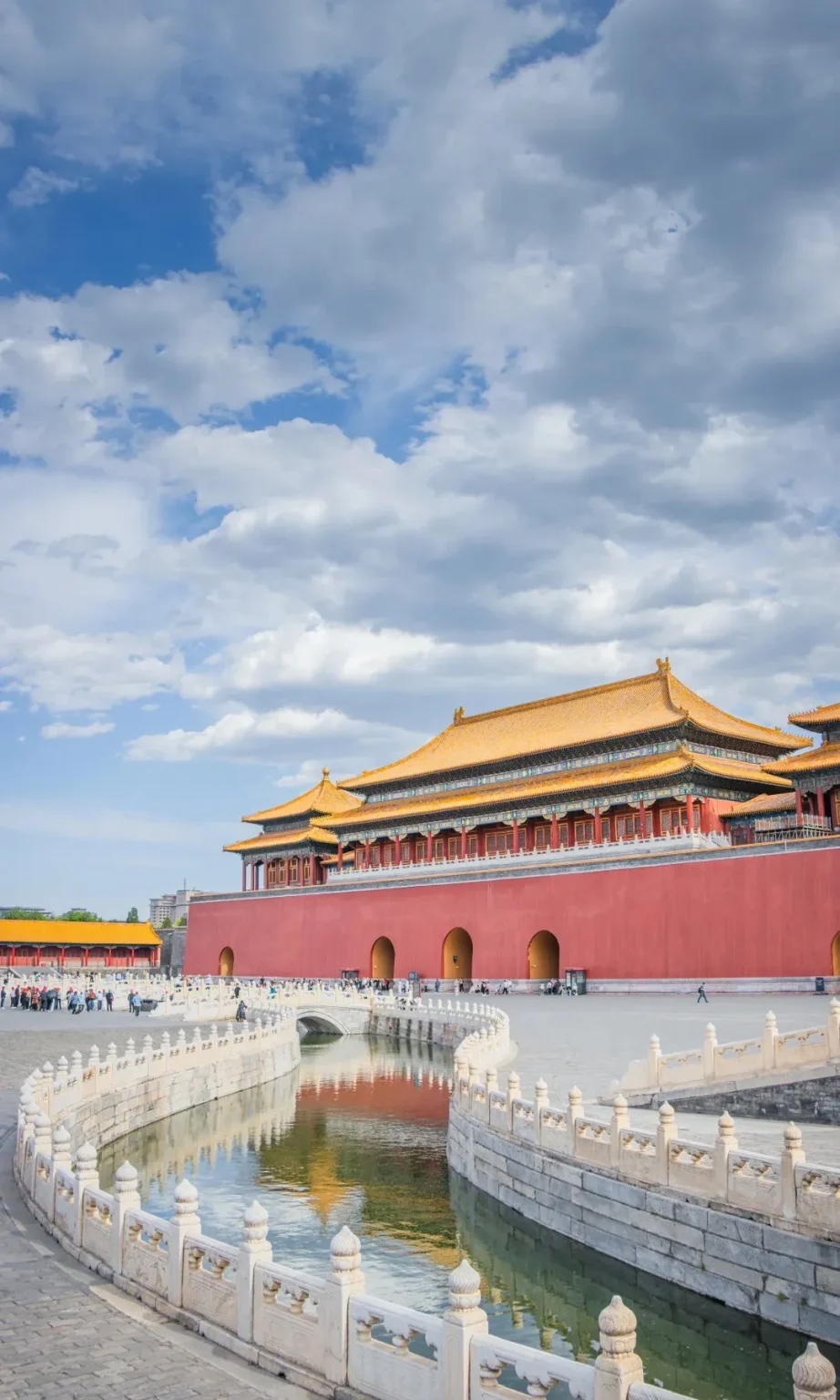
A wide shot of a curved, ornate white stone moat surrounding the red walls of the Forbidden City in Beijing. Golden-roofed traditional Chinese architecture is visible behind the walls, and a white arched bridge crosses the moat. The sky is filled with fluffy white clouds against a blue background.

The iconic red walls and golden roofs of the Forbidden City, a key landmark on Beijing’s Central Axis, are reflected in the tranquil waters of its surrounding moat. This UNESCO World Heritage site is a testament to China’s imperial past.

Exit the Forbidden City via the North Gate (Gate of Divine Prowess) and cross the street directly into Jingshan Park. Entry is a mere ¥2.

The steep, calf-burning climb to the Wanchun Pavilion takes about 15 minutes, but the payoff is unmatched. This artificial hill, built from the earth excavated from the palace moats, sits at the exact geometric center of historic Beijing. The panoramic view of the Forbidden City’s golden roofs stretching southward is the most rewarding photo opportunity in the capital.

Stop 5: The Bell and Drum Towers

Descend Jingshan and walk north along Di’anmen Inner Street, crossing the ancient Wanning Bridge. Your final destination is the towering duo of the Bell and Drum Towers (Zhonggulou), which historically kept time for the entire city.

Climb the impossibly steep wooden stairs of the Drum Tower just before 5:00 PM to catch the final drum performance of the day. Afterward, reward your exhausted legs with a craft beer or a bowl of noodles in the trendy, atmospheric Gulou hutongs surrounding the towers.

Common Questions About Traveling to China

Do I need a visa for a short trip to Beijing?

You may be eligible for the 144-hour visa-free transit policy if you are a citizen of one of the 54 eligible countries. This allows you to stay in the Beijing and Jing-Jin-Ji region for up to six days without a visa, provided you have a confirmed onward flight to a third country.

While cash is legal tender, it is rarely accepted in practice. You must download Alipay or WeChat Pay and link your foreign Visa or Mastercard before arriving to pay for transportation, food, and entrance tickets.

Walk-up tickets are not available. You must book exactly seven days in advance at 8:00 PM Beijing time via the official ‘Palace Museum’ WeChat Mini Program, as tickets typically sell out within minutes.

Standard roaming plans are often unreliable and cannot bypass China’s internet restrictions. It is highly recommended to purchase an eSIM specifically designed for China to ensure you can access navigation and essential travel apps.

Conclusion

Walking the Beijing Central Axis is a masterclass in Chinese history, urban planning, and architectural grandeur. While the 7.8-kilometer trek is physically demanding and logistically complex, tracing the footsteps of emperors offers an unparalleled connection to the city’s soul. Ensure your digital payment apps are loaded, your eSIM is active, and your tickets are booked well in advance. If you’re ready to explore beyond the city center, check out our dedicated guide to choosing the best unrestored sections of the Great Wall for your next adventure.

Similar posts to this one

A close-up, blurred foreground of a stone Buddha statue in profile, with its hand raised in a gesture. In the background, a tall, yellow, multi-tiered pagoda stands against a blue sky with scattered clouds. Green trees are visible at the base of the pagoda.

Hanyangling Museum Guide: Xi'an's Best Kept Secret Underground

Most travelers flock to Xi'an for the Terracotta Warriors, only to find themselves shoulder-to-shoulder with thousands of tourists in sweltering, [...]

A vibrant, overhead view of numerous bouquets of flowers for sale at a market. In the foreground, there are large bunches of light pink roses, pale peach roses, and light purple hydrangeas. Behind these, a wide array of colorful roses are visible in various shades of yellow, pink, red, and lavender, many wrapped in clear plastic. The flowers are densely packed together, creating a visually rich tapestry of color.

Dounan Flower Market Guide: Visiting the World's Largest Floral Hub in Kunming

Stepping into the Dounan Flower Market hits you with an overwhelming wave of sensory details: the sharp, sweet scent of [...]

A large, ancient stone carving of Guanyin seated on a lotus throne, adorned with ornate jewelry and flowing robes, set within a cave-like structure. The statue is weathered and colorful, with intricate details in the carving of the deity and the surrounding rock formations. A young woman with a red headband stands on the right, looking up at the statue from behind a wooden railing.

Anyue Stone Carvings: A Guide to Sichuan's Hidden Grottoes

If you want to experience ancient Chinese Buddhist art without battling umbrella-wielding tour groups, you need to look beyond the [...]

Get the China Arrival Survival Kit

Planning a trip here has a steep learning curve. Join our newsletter and receive our free “Day One Checklist” covering everything from setting up Alipay and WeChat to bypassing the internet firewall.